
The Nasdaq fell 5.5% on Thursday. Friday's jobs report added 165,000 workers. The correction repriced one trade — the AI buildout — not the economy underneath it.
4 min read
The market delivered two verdicts in eighteen hours, and they point in opposite directions.
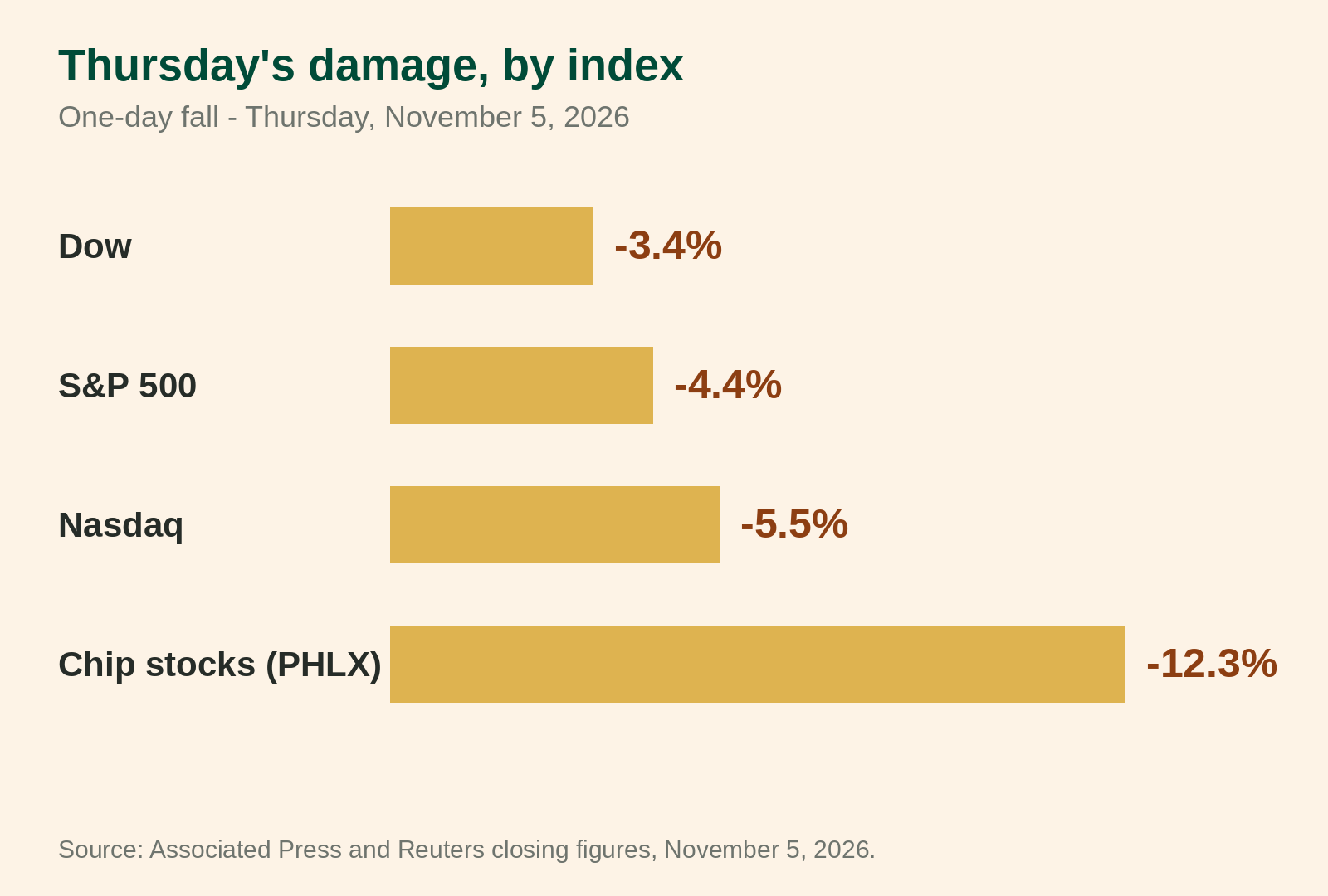
Thursday’s verdict was the Nasdaq’s worst day since April 2025: down 5.5% to 24,315, a record 1,422 points gone in a session, and the index officially in correction, about 12% below its October 6 record. The S&P 500 fell 4.4%. Roughly $2 trillion of Nasdaq value vanished.
Friday morning’s verdict came from the Labor Department. Employers added 165,000 jobs in October — two and a half times what economists expected. Unemployment slipped to 4.1%. The prior two months were revised up by another 84,000 jobs. That is not what an economy rolling over looks like.
So what fell on Thursday?
One trade did. The semiconductor index fell 12.3% in a day, its second-worst session on record. The selling started where the story changed: Democrats swept the midterms, and the buildout that carried the market now faces governors who campaigned on slowing it. By one bank’s count, about 30% of the data-center capacity planned for 2028 sits in states whose incoming governors promised to slow or stop construction. The AI trade’s question moved this week — from whether customers will pay for the computing to whether the buildings get built at all.
Here is the honest counterweight: Thursday did not stay contained. All eleven S&P sectors fell. Four hundred twenty-nine of the index’s 500 stocks closed down. Fear is contagious, and a 10-stock-heavy index — the top ten were 39.2% of the S&P 500 a month ago, 37.3% now — transmits one trade’s bad week to everyone’s retirement account. If the selling keeps spreading after the story is priced in, the story stops being the explanation.
But a correction that begins in one trade is a different animal from one that begins in the economy, and Friday’s report is the evidence. Hiring is not falling. Wages are still rising. Nothing in the data says the country stopped earning; the market simply repriced what one industry’s future is worth now that politics has a say in it.
Friday’s close backed the jobs report’s version of events. The Nasdaq rose 1.1% to 24,579, the S&P 500 added 0.3% to 7,377, and the semiconductor index bounced 4.2% to 9,390 — recovering about a third of Thursday’s 12.3% plunge, with AMD up 11% and Nvidia up 2.8%. The morning bounce held: Nasdaq futures were up 1.4% before the open, and the index never gave the gain back.
The split in the close is the honest part. The Dow slipped 0.5% to 51,286, because the same jobs report that steadied stocks also kept a December rate hike on the table — the odds held at 78%, and the 10-year yield closed at 4.86%. And the week still ended red: the S&P 500 fell 2.7% and the Nasdaq 3.4%, their worst week since June. The Nasdaq is still about 11% below its October 6 record. A bounce is not a bottom. But Friday drew the line the piece draws: the selling stopped where the story changed, and the economy underneath kept hiring.
The test comes fast. Nvidia reports around November 17 — the first earnings read on the buildout since the selloff. If the chip numbers hold, Thursday will look like what the jobs report says it was: a repricing, not a crack. If they wobble, the correction gets a second chapter, and it will not stay inside one trade.
Winners
- Workers: 165,000 jobs, unemployment at 4.1%, wages up 3.1% on the year.
- Gold: up 5.5% on the week. The insurance policy paid on the one day it was needed.
Losers
- The AI trade: semiconductors down 12.3% in a day, and a new risk — permitting politics — that no earnings beat can answer.
- Borrowers: a jobs report this strong put a December rate hike back on the table; the odds jumped to 78%, and the 10-year yield rose toward 4.88%.
⚡ Spark Takeaway: A correction that starts in one trade is a repricing. A correction that starts in the economy is a warning. This week delivered the first kind — and Friday’s jobs report is the receipt.
Sources: Bureau of Labor Statistics Employment Situation, October 2026 (November 6, 2026); Associated Press and Reuters closing figures, November 5–6, 2026; Nasdaq OMX PHLX Semiconductor Index history, November 6, 2026 (close 9,390.25, +4.21%); S&P Dow Jones Indices S&P 500 factsheet, October 30, 2026.
LISTEN TO THIS STORY
Daniel Reyes reads his story, 5 minutes 22 seconds.
Listen on Apple Podcasts · Listen on Spotify · Subscribe in another podcast app
KEEP READING
- What a Market Correction Is — the explainer: what the 10% label means and what it doesn’t.
- 165,000 Jobs, a Record Plunge, and the Phone Tax — the week’s roundup, including Thursday’s rout.
- The AI Bubble Watch — the standing scoreboard: Burst Risk held at 50% through the rout.
New posts by email
One short email when a new Financial Spark story publishes. No newsletter, no spam — unsubscribe anytime.