Employers added 165,000 jobs in October — two and a half times what economists expected. The Fed's December decision just got harder.
4 min read
LISTEN TO THIS STORY
Marcus Bell reads his story, 4 minutes 35 seconds.
Listen on Apple Podcasts · Listen on Spotify · Subscribe in another podcast app
Story 1 — The jobs report put the December rate hike back on the table
Event: Employers added 165,000 jobs in October, the Labor Department said Friday morning — more than two and a half times the 65,000 economists expected. The unemployment rate slipped to 4.1%, from 4.2%. The two prior months were revised up by a combined 84,000 jobs. Wages rose 0.4% in the month, to $38.00 an hour, and 3.1% over the year.
Money angle: A jobs report this strong, a day after the market’s worst selloff since April, does two things at once. It says the economy is hiring at a pace nobody forecast. And it gives the Fed room to do the thing the market fears most: raise rates in December. The odds of a hike jumped to 78% after the print, and the 10-year yield rose to about 4.88%. Good news for workers. Complicated news for borrowers.
Story 2 — Thursday was the Nasdaq’s worst day since April 2025
Event: The Nasdaq fell 5.5% on Thursday to 24,315, a record 1,422-point single-session loss, and is now in correction — about 12% below its October 6 record. The S&P 500 fell 4.4%. The Dow lost 1,833 points. The semiconductor index fell 12.3%, its second-worst day on record. Roughly $2 trillion in Nasdaq value vanished in one session.
Money angle: The trigger was politics, not earnings. Democrats swept both chambers in the midterms, and the market’s first question was what that means for the data-center buildout. About 30% of the capacity additions planned for 2028 now sit in states where the new governors promised to slow or stop construction, by one bank’s count. The AI trade’s risk has moved. It is no longer just whether customers will pay for the computing. It is whether states will let the buildings go up.
Story 3 — The AI boom is now taxing the phone in your pocket
Event: This is not the Apple earnings recap from Monday. It is what the earnings revealed about costs. Apple’s revenue rose 12% to $114.5 billion, with iPhone sales up 17% to $57.6 billion — but the company cut its December-quarter margin guide to 45–46%, and its new chief executive said memory pricing is “unprecedented.” Qualcomm’s handset chip revenue fell 26% to $5.14 billion. Smartphone shipments fell 20% in the quarter, a 14-year low.
Money angle: Data centers are buying so much memory that memory prices are squeezing the margins on phones and chips. The buildout’s bill is no longer confined to the companies building it. It is landing on ordinary hardware, in the form of higher costs for the device in your pocket. When the world’s biggest buyer of memory is a data center, your phone pays the markup.
October payrolls vs expectations
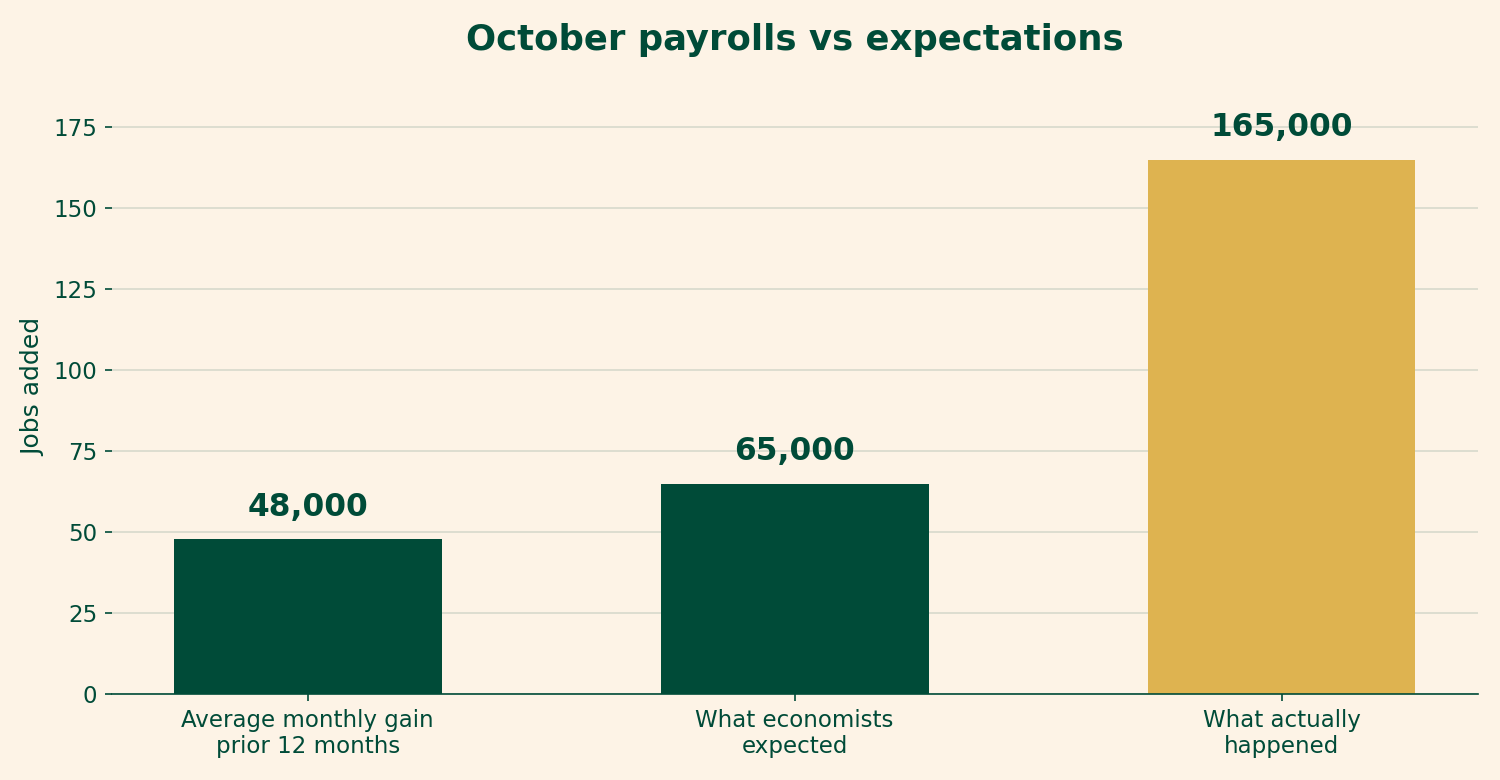
Source: Bureau of Labor Statistics Employment Situation, October 2026, via Reuters, November 6, 2026.
🏆 This Week’s Strongest FinancialSpark Story
The jobs report.
A week that began with an election and ended with a rout produced one number that changes the next decision. The Fed meets December 8–9, and until Friday morning the question was whether it would hold rates steady. Now the question is whether it raises them. That is a different December.
The lesson is an old one, and the week made it new again. A strong economy is not always good news for the market. When hiring runs hot and inflation is still above target — September prices rose 3.7% over the year — the Fed’s job gets harder, not easier. Workers got the number they wanted. Borrowers got the number they feared. Same report. Two different readings. Tuesday’s inflation report will say which one the Fed listens to.
KEEP READING
- The Index Fell. Most of Its Stocks Rose. — Thursday’s AI selloff, from the Asia side: the political price tag on the buildout.
- The AI Bubble Watch — the standing scoreboard for AI spending versus disclosed AI revenue, refreshed with this week’s figures.
- The Spark Board — the week’s numbers that matter, including the mortgage rate and the gas price.
New posts by email
One short email when a new Financial Spark story publishes. No newsletter, no spam — unsubscribe anytime.