
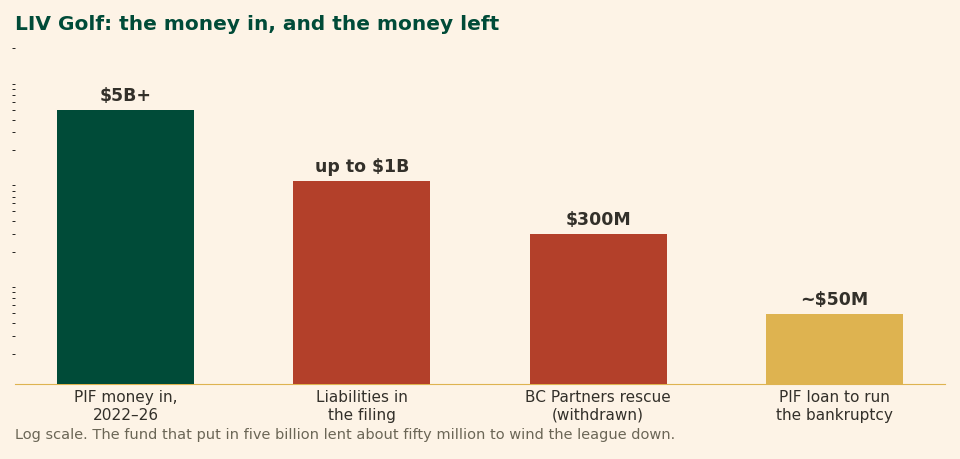
A $300 million rescue for LIV Golf died because the players would not sign. Five billion dollars of Saudi money built a league that could not survive its own bank statement.
6 min read
LISTEN TO THIS STORY
Claire Donovan reads her story, 7 minutes 35 seconds. From the Financial Spark audio edition.
Listen on Apple Podcasts · Listen on Spotify · Subscribe in another podcast app
A $300 million rescue died this week, and it did not die over money. It died over signatures.
BC Partners, the firm that agreed last month to finance a relaunch of LIV Golf, walked away on Wednesday. The reason, reported by the Financial Times: the league could not produce enough players willing to commit to it. LIV appears in bankruptcy court in Trenton, New Jersey today, where the relaunch was expected to be declared unworkable and the wind-down to begin.
The richest experiment in sports history is ending not with a bidding war, but with a list of people who would not sign.
A league in a courtroom
LIV filed for Chapter 11 protection in September, listing assets of $100 million to $500 million against liabilities of $500 million to $1 billion. Two 2026 events were cancelled. The league’s best stop, in Adelaide — publicly funded by South Australia — has all but been abandoned, and the host club has filed in the case over an unpaid venue fee. The state’s premier, Peter Malinauskas, put it plainly: “It feels like it’s game, set and match as far as I can tell.”
The players went first. Jon Rahm, Tyrrell Hatton, Sergio Garcia and Ian Poulter are among more than a dozen who declined the relaunch — a player-owned model that swapped guaranteed contracts for equity. Rahm was blunt this week: “I wasn’t thrilled with the changes they were doing to 2.0 and I just wasn’t willing to follow that path.” Rahm and Bryson DeChambeau now sit in the filing itself — as unsecured creditors, owed $7.47 million and $5.77 million the league had not paid.
Why the money never had to make sense
None of this arithmetic ever had to work, because LIV was never really a business. It was a purchase.
The buyer was Saudi Arabia’s Public Investment Fund, the sovereign wealth fund behind Vision 2030 — the kingdom’s plan to diversify its economy and its image at the same time. The fund’s sports spending — a Premier League soccer club, Formula 1, boxing, tennis — has one consistent job: put Saudi Arabia at tables it used to be kept away from. Critics call the strategy sportswashing. Golf was the most establishment table of all, and the fund bought the whole room: more than $5 billion in five years, a signing bonus for Rahm reported above $300 million, $30 million purses for tournaments with tiny television audiences.
The tell came in June 2023, when the PGA Tour itself announced a framework agreement with the fund. The merger never fully closed. It did not need to. The establishment had already negotiated with the PIF as an equal, which was what the money was buying.
That is why the exit makes sense. A business dies when its revenue fails. LIV never built revenue to fail — no real television money, no gate that mattered, sponsors that never offset the guarantees. It ended when the purchase was complete. In April, the fund said so in its own words: “The substantial investment required by LIV Golf over a longer term is no longer consistent with the current phase of PIF’s investment strategy.” Its new five-year strategy, published the same month, does not mention the league at all.
The bailout that isn’t coming
Could the fund save LIV tomorrow with a fraction of what it has already spent? Easily. It will not, and the bankruptcy filing shows why. The PIF provided roughly $50 million in debtor-in-possession financing — enough to run an orderly wind-down — while fully exiting as owner. That is not a rescue down payment. It is paying for a clean departure.
The fund is cutting everywhere at once: megaprojects shelved, a flagship soccer team sold, sports spending in retreat under a strategy it calls value realization. Another few hundred million would buy the right to keep funding a league whose own chief executive put profitability five to ten years away. There is nothing left to buy. The legitimacy was delivered years ago.
The honest counterweight
LIV did change golf. The PGA Tour raised its purses and created an equity program for its players — reforms it had resisted for decades, made under threat. The players who took the guarantees banked generational money; Lucas Herbert, who also left this fall, made more than $25 million on the course in three seasons. Adelaide proved the format could draw a crowd. The experiment was not nothing. It was just never a business.
Winners
- The players who took the guarantees early — the money was real, it cleared, and the biggest checks in golf history are already banked
- The PGA Tour, which outlasted the threat and now fields return requests on its own terms
- The PIF, on its own scorecard: normalization, access and a framework agreement with the establishment, for roughly what a mid-size acquisition costs
Losers
- The players who stayed to the end, and the staff: most employees laid off, late joiners’ contracts sitting in a bankruptcy queue
- Venues and vendors in the creditor line — IMG alone is owed about $3.2 million, and an Australian host club is chasing an unpaid venue fee
- Adelaide’s taxpayers, who funded the league’s one genuine success story and are left holding the cancellation
⚡ Spark Takeaway: When the money isn’t the point, the money can stop at any time. LIV’s players, venues and employees all built on a patron’s strategy — and a strategy, unlike a business, can be completed.
Update — November 5, 2026: At Thursday’s hearing in Trenton, LIV Golf’s lawyers told Judge Michael B. Kaplan the relaunch is dead: the league is no longer pursuing LIV 2.0 and will move its Chapter 11 case into liquidation, winding down operations. “We just couldn’t get to the level of combined financial and player support necessary for a viable LIV 2.0 in the required timeline,” LIV attorney Matthew Williams said in court, after BC Partners pulled out of its plan to provide up to $300 million in funding. LIV confirmed the same day that its restructuring support agreement with BC Partners has been terminated and it intends an orderly wind-down, while remaining open to value-maximizing alternatives. (Sources: USA Today; LIV Golf announcement via Business Wire.)
Sources: Reuters, reporting the Financial Times on BC Partners’ withdrawal and the South Australia premier’s remarks; GOLF.com, on the expected wind-down; USA Today, on Jon Rahm’s comments and the bankruptcy case; JD Supra’s analysis of the first-day declaration, on the filing, the creditor list and the PIF financing.
KEEP READING —
- The NBA Is Turning Predictions Into a Business — the other league building on money that is not ticket sales
- The Index Fell. Most of Its Stocks Rose. — today’s other repricing: what happens when a crowded trade meets politics
- The Spark Board — the week’s numbers in one place
New posts by email
One short email when a new Financial Spark story publishes. No newsletter, no spam — unsubscribe anytime.