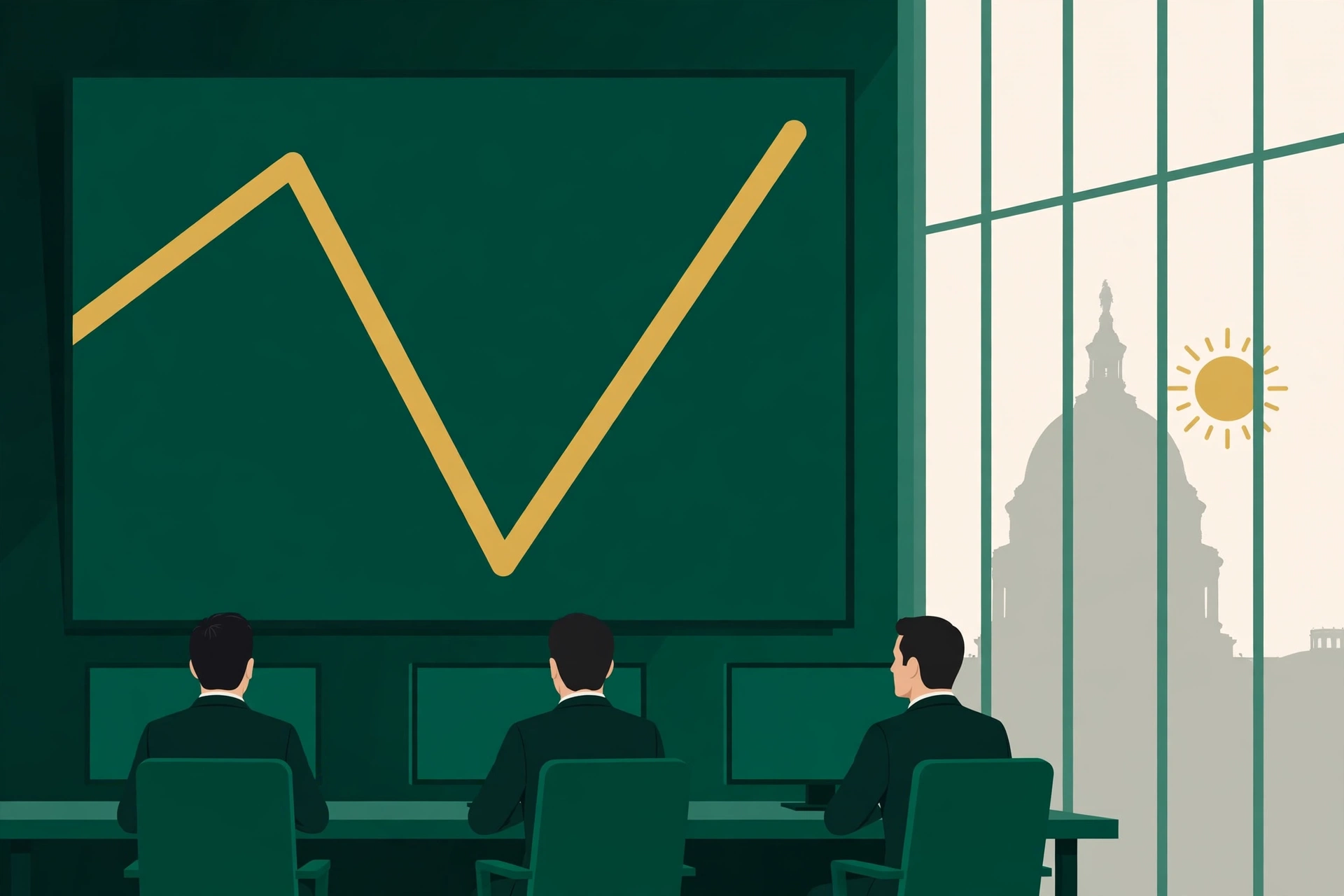
Futures crashed on a Democratic sweep, then reversed by morning. The market was not voting on the winners. It was voting on how little can change.
5 min read
The market’s first verdict on the midterm elections took about three hours. Its second verdict overturned the first before the opening bell.
Democrats took both chambers on Tuesday, flipping Senate seats in Texas, South Carolina, Kansas, and Ohio, and winning a House majority that forecasters project in the mid-240s or higher once counting finishes. As the results landed overnight, Nasdaq futures fell more than 2%. The S&P 500 futures dropped with them. Chipmakers in Asia — Samsung, SK Hynix, TSMC — sold off sharply, the dollar slid to a one-month low, and money ran into bonds, pushing the 10-year Treasury yield down 6 basis points to 4.906%.
The fear had a name: oversight. A Democratic Congress means hearings on AI, questions about data centers’ power and water use, and a harder road for the buildout the entire AI trade is priced on. “Tighter regulatory scrutiny of technology and AI companies along with the higher likelihood of political gridlock beckon with a Democrat sweep,” said Prashant Newnaha of TD Securities.
Then traders did the second piece of math. Democrats hold both chambers, but the president holds a veto, and most legislation still needs 60 votes in the Senate. The new Congress’s real powers are oversight, the budget, and blocking — not enacting. Tax cuts are on ice. New spending is on ice. Almost everything is on ice. By morning, Nasdaq, S&P 500, and Dow futures were all positive. “We are in the best possible outcome for markets,” said Lombard Odier’s Nannette Hechler-Fayd’herbe. The sector moves told the same story of repricing by exposure rather than panic: data-center stocks dipped, solar names jumped — First Solar up 9.4%, Sunrun up 10% — defense and prison stocks fell, and hospitals and insurers rose.
The honest counterweight: nothing in Washington has actually changed yet. The new Congress is not seated until January, and the permits that decide whether a data center gets built are issued by state commissions and county boards, not by Congress. The overnight selloff priced a federal threat to the AI buildout that was always the smaller half of the story.
What gridlock cannot stop is the half of government that never needed Congress. Tariffs are set by the executive. So are immigration enforcement and agency rules. House Democrats have promised an early vote to roll the tariffs back; the president has a veto, and the arithmetic ends there. If anything, a blocked legislative agenda pushes more policy through the one channel that still moves — the one that sets import prices.
Gridlock also cannot move the calendar. Federal funding expires December 11, in the lame-duck session. The debt ceiling’s deadline lands in mid-to-late summer 2027, against a Congress that just won big and a president who does not bend. Those are the two dates when “nothing gets done” stops being a comfort and becomes a position traders have to price.
Bitcoin traced the same V as everything else. It slid below $76,000 overnight as the sweep landed, then recovered to about $78,300 by morning, up on the day. What stayed down was narrower: the tokens tied to the president’s own circle, off 5% to 7%.
One more scoreboard from the night: prediction markets called the sweep near 100% by 9 PM ET, ahead of the networks, on more than $1.48 billion wagered — and this time it was Kalshi, not Polymarket, carrying most of the volume.
President Trump told The Wall Street Journal that gas prices, driven up by the conflict with Iran, were partly to blame for the result. Voters delivered their verdict on prices. The market delivered two on power — and the second one says the less Washington can do, the better. The test of that verdict is not a vote count. It is whether anything on the December calendar, or the tariff schedule, actually stays frozen.
Winners:
- Bonds — the 10-year yield fell to 4.906% as money bought safety and gridlock in equal measure
- Solar and clean energy — First Solar +9.4%, Sunrun +10% on the new Congress’s expected priorities
- Hospitals and insurers — up on the same policy-exposure repricing
- Kalshi — the prediction market that carried the night’s volume and called the sweep early
Losers:
- The dollar — down to a one-month low as futures whipsawed
- Trump-linked crypto tokens — the official Trump token fell 7.1% and World Liberty Financial 5%, even as bitcoin recovered
- Defense and prison stocks — down on expected Democratic budget pressure
- Tesla and SpaceX — both down about 5% premarket, and still down before the open while index futures rose
⚡ Spark Takeaway: Election night did not change what Washington will do. It changed what Washington can do — and the market’s second, calmer verdict is that a government that cannot move is a government that cannot surprise it. The tariffs and the deadlines never got that memo.
Sources: Reuters and Associated Press election results and market coverage, November 3–4, 2026; Dow Jones market reporting, November 4, 2026; strategist comments as quoted by Reuters.
KEEP READING
New posts by email
One short email when a new Financial Spark story publishes. No newsletter, no spam — unsubscribe anytime.