Apple posted a record quarter and the stock fell anyway. A $1.2 billion China miss, tariff refunds inside the beat, and a cautious holiday guide explain why.
3 min read
Apple reported the best September quarter in its history on Monday. The stock fell anyway.
Shares closed down 1.8% at $338.32 before the numbers, then dropped another 2.8% after hours, to about $329. That is the market’s verdict, and it was not about the quarter that just ended.
The quarter itself beat nearly everything. Revenue was $114.48 billion, up 12% from a year ago and ahead of the $113.39 billion analysts expected. Earnings were $2.10 a share against roughly $1.99 expected. Net income was $30.71 billion.
iPhone revenue hit $57.58 billion, up 17.5%, a September-quarter record. Services set an all-time high at $31.57 billion. Mac beat expectations at $10.79 billion. The full fiscal year closed at $479 billion in revenue, another record.
So the counterweight is real: this was a strong report, from a company still growing double digits at a size where that is supposed to be hard.
The problems sat in two places. The first was China.
Greater China revenue came in at $17.54 billion. Analysts had modeled $18.75 billion. The gap is about $1.2 billion — the biggest single miss in the report.
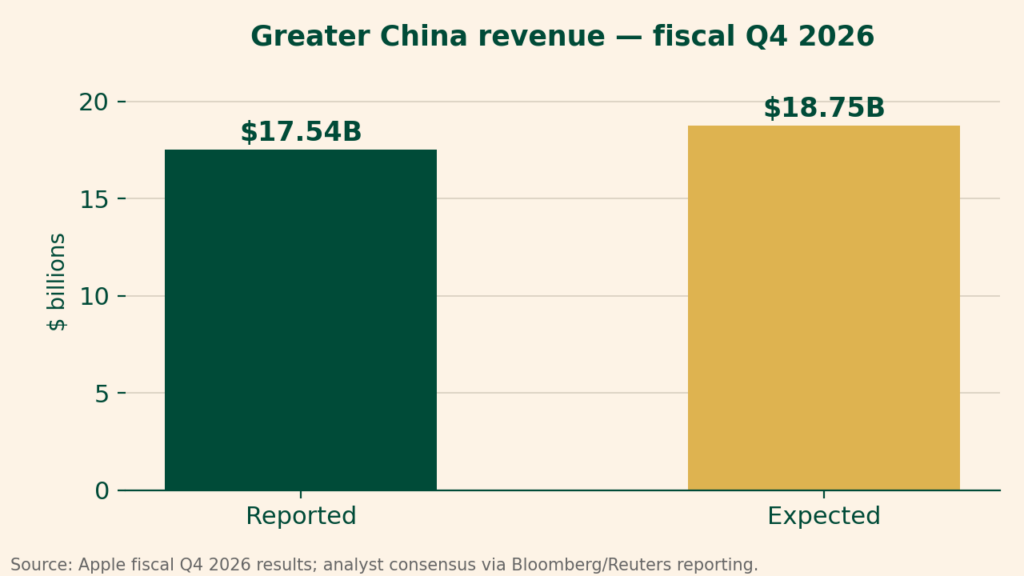
China did not shrink. Sales there grew 21% year over year, a quarterly record. They just grew far less than the roughly 28% jump the Street had penciled in, in the market where Huawei is taking share back and where Apple’s standard iPhone went without its usual September update. Apple’s answer starts this week: Apple Intelligence begins testing in China on November 4, running on Alibaba’s Qwen models.
The second problem was the future, which is the part the market actually prices. For the December quarter — Apple’s biggest of the year — the company guided revenue growth of 7% to 10%. That would still be the largest revenue quarter in Apple’s history. Analysts had expected closer to 11%.
Gross margin guidance told the same story: 45% to 46%, down from 47.9% this quarter. The reason is memory chips. The same AI building boom filling data centers has bid up memory prices, and Apple buys memory by the trainload. Chief executive John Ternus, in his first report as CEO, called the memory situation “unprecedented” and said costs will keep rising past December. Apple has been stockpiling ahead of it — inventories jumped 31% in one quarter, to $14.54 billion.
One more line inside the beat deserves a footnote. Earnings included a $0.05-a-share benefit from $731 million in tariff refunds, worth about a point of that 47.9% margin. Without the refunds, earnings still beat — $2.05 against $1.99 — but the government’s rebate was part of the margin story, not Apple’s pricing power.
Winners
- iPhone buyers at the top end: Pro models carried the quarter, up 17.5% on higher prices.
- Services subscribers, as a business line: a $31.57 billion record, and the steadiest number Apple prints.
- Memory-chip makers: their pricing power now reaches all the way into Apple’s guidance.
Losers
- Apple shareholders tonight: down about 2.8% after hours on a record quarter.
- Anyone waiting for cheaper Apple hardware: rising memory costs and a 45% to 46% margin guide point to prices holding, or rising.
- The consensus model: China, iPad ($6.23 billion, below the $6.9 billion expected), and wearables ($8.3 billion, below $9 billion) all missed at once.
⚡ Spark Takeaway: The market was not repricing Apple’s past — it was repricing how much of Apple’s future runs through memory prices and Chinese buyers, the two things Apple controls least.
Sources: Apple’s fiscal Q4 2026 earnings release and Form 8-K (November 2, 2026); Reuters and LSEG analyst estimates; Seoul Economic Daily earnings-call report; Finnhub closing and after-hours prices, November 2, 2026.
KEEP READING
- Microsoft Passed the Cash Test. Alphabet Doubled Its Cloud and Still Fell.
- Amazon’s Store Paid for the Cloud. It Still Wasn’t Enough.
- The AI Bubble Watch
New posts by email
One short email when a new Financial Spark story publishes. No newsletter, no spam — unsubscribe anytime.