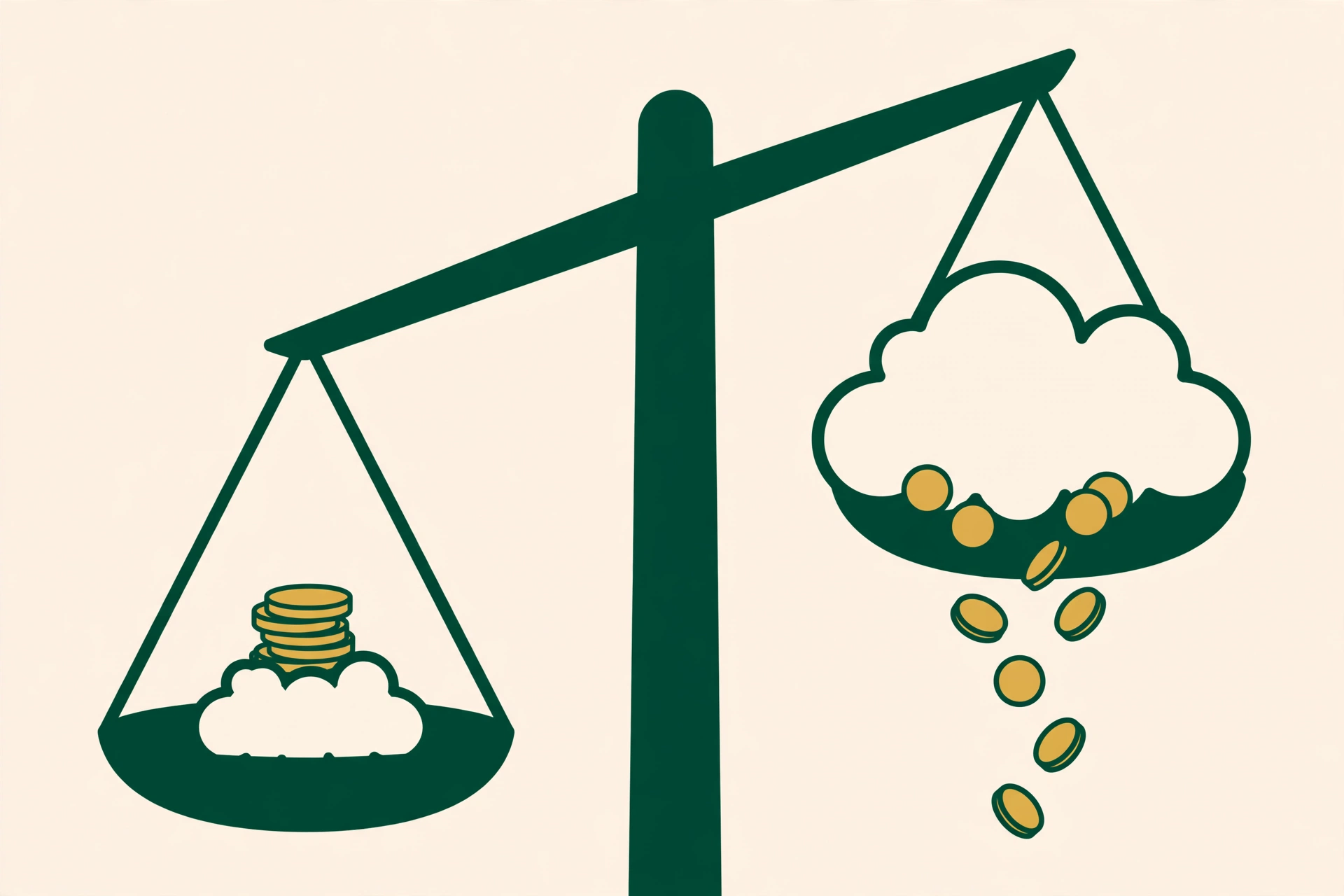
Microsoft beat and rose. Alphabet doubled its cloud and fell. The difference was cash, not growth.
7 min read
Wednesday gave investors two versions of the same story, and the market picked one fast.
Microsoft reported first, Alphabet second, and by the evening the verdict was plain. Growth was not the question. Both companies grew their cloud businesses at a pace most companies would envy. Cash was the question. One company still generates it after paying the AI bill. The other, for a second straight quarter, does not.
That is the puzzle this scorecard answers. Why does a cloud business that more than doubles still lose 9% in an evening, while a cloud business growing half as fast gains 4%?
Because in this boom, the bill arrives before the payoff, and investors have started checking who can pay it out of pocket.
The Fed, first
The Federal Reserve held its benchmark rate at 3.75% to 4.00% on Wednesday, in a 10–2 vote.
Two officials, Governor Lisa Cook and Cleveland Fed President Beth Hammack, dissented in favor of raising rates another quarter point. The statement upgraded its description of the economy from “solid” to “strong,” kept the warning that inflation “remains elevated,” and said more information will help determine the policy stance needed to return inflation to 2%.
What the Fed decision adds, in one line each:
- For borrowers: no relief, and no promise of any — rates stay where September’s hike put them, with another hike still on the table for December.
- For the AI spenders: the building boom is being financed at high rates, not cheap ones, which makes the cash-flow question in this post the question that matters.
Microsoft: the beat that paid for itself
Microsoft’s fiscal first quarter, covering July through September, was a beat on the lines investors watch.
Revenue rose 19% to $92.3 billion, above the $90.7 billion analysts expected. Adjusted earnings were $4.89 a share, above the $4.73 expected. Operating income rose 21% to $45.9 billion.
The headline inside the headline was Azure. For the first time, Microsoft put a dollar figure on it: $33.2 billion of revenue, up 48% from a year earlier and up from 42% growth the quarter before. That beat the $32.3 billion analysts expected. Microsoft Cloud revenue, which bundles Azure with cloud versions of Office and other online services, rose 30% to $63.9 billion.
Here is the number that moved the stock. Microsoft spent $45.2 billion on capital expenditures and finance leases in the quarter, up about 30% from a year earlier, but below the roughly $50.7 billion analysts expected. Free cash flow came in at $18.6 billion, well above the $8.5 billion analysts expected.
Think of it the way a household would. The renovation is expensive, and getting more expensive. But the paycheck covered it, with money left over. That is what investors rewarded.
The honest counterweight: the spending is not slowing. Microsoft expects capital spending above $50 billion in the current quarter, and says spending will accelerate in the second half of its fiscal year as delayed third-party capacity arrives. Its Azure growth guide for the current quarter, 49% to 50%, is strong, but it is a guide, not a result. And Microsoft disclosed no new AI revenue run rate — its $37 billion figure from April stands, un-updated, while Copilot’s user count rose about 50% from the June quarter without a new paid-seat number.
Alphabet: the cloud doubled, and the cash went negative
Alphabet’s third quarter, also covering July through September, was the mirror image.
Revenue rose 25% to $127.6 billion, slightly below the $128.2 billion analysts expected. Google Cloud revenue more than doubled, up 103% to $30.7 billion, beating the $29.6 billion analysts expected. Cloud operating income rose to $11.1 billion, from $3.6 billion a year earlier. Search revenue rose 12% to $63.4 billion, but that missed the $65.0 billion analysts expected, and the miss landed where it hurts most — in the core advertising business that funds everything else.
Operating income still rose 30% to $40.6 billion. Reported earnings fell to $2.12 a share, from $2.87 a year earlier, after an $8.7 billion loss on equity securities that cut earnings by $0.55 a share. That paper loss explains much of the profit drop. It does not explain the cash.
Capital spending was $51.4 billion in the quarter, up from $24.0 billion a year earlier. Operating cash flow was $42.3 billion. Free cash flow was negative $9.07 billion, worse than the roughly break-even result analysts expected, and the second straight negative quarter after negative $5.86 billion in the second quarter.
Alphabet kept its 2026 spending range at $195 billion to $205 billion and said 2027 spending will increase significantly, without giving a figure. It also raised $28.7 billion from senior notes and sold $12.4 billion of stock in the quarter, while repurchasing none.
Back to the household. The renovation here is bigger than the paycheck, for a second quarter running, and the family just told the bank the next renovation will be bigger still. Cloud growth of 103% is real demand — the backlog reached about $560 billion — but demand that has to be built before it can be billed is demand that eats cash first.
The honest counterweight: Alphabet’s problem is not a broken business. Search still grew 12%, YouTube advertising rose 9% to $11.2 billion, and the cloud backlog means contracted work is waiting for capacity. The question is not whether customers want what Alphabet is building. It is whether the bill for building it keeps arriving faster than the cash from selling it.
Winners
- Microsoft shareholders. A beat on revenue, earnings, Azure, and cash flow, in the same quarter. The market’s reward was about 4% after hours.
- Anyone selling shovels to the cloud builders. Both companies are still spending at a record pace, and Alphabet just promised more in 2027. The suppliers’ order books are the safest line in this story.
- Microsoft’s cloud customers, oddly enough. Azure growing 48% with capacity still arriving late means demand is not the constraint. Supply is.
- Readers of the cash-flow statement. Two quarters ago, revenue growth settled arguments. Now the statement that shows cash in minus cash out does.
Losers
- Alphabet shareholders, for the evening. About 9% after hours, despite the fastest cloud growth of the night. The market punished the cash burn and the search miss, not the cloud.
- The “growth excuses everything” argument. Google Cloud doubled, and the stock fell anyway. Growth that costs more cash than it generates is a claim on the future, not a result.
- Alphabet’s buyback. There was none in the quarter, while new stock was sold. Shareholders funded the build-out twice over: once in a lower stock price, once in dilution.
- The December rate-cut hope, such as it was. The Fed’s hold, with two votes for a hike, leaves borrowing costs high for companies financing data centers with debt.
After-hours stock moves, Wednesday, October 28, 2026
Source: CNBC market data, early evening October 28, 2026, as reported in earnings coverage. Moves are after-hours, not full-session results, and will change by Thursday’s open.
⚡ Spark Takeaway
Growth tells you customers showed up. Cash tells you whether the business paid for the party itself. On Wednesday, one company did, and one asked its shareholders to pick up the tab.
Sources: Federal Reserve FOMC statement, October 28, 2026; Microsoft fiscal Q1 2027 earnings release and earnings call; Alphabet Q3 2026 earnings release and earnings call; after-hours market data via CNBC. Reporting by Reuters and CNBC.
KEEP READING
The Tenant Just Turned a Profit — Anthropic’s profitable quarter, and why a company that rents its computers reports the cleanest numbers in AI.
The AI Bubble Watch — the standing scoreboard for AI spending versus disclosed AI revenue, and the Burst Risk gauge this week’s numbers will feed.
The Spark Board — the week’s numbers that matter, including the rates the Fed just left unchanged.
New posts by email
One short email when a new Financial Spark story publishes. No newsletter, no spam — unsubscribe anytime.