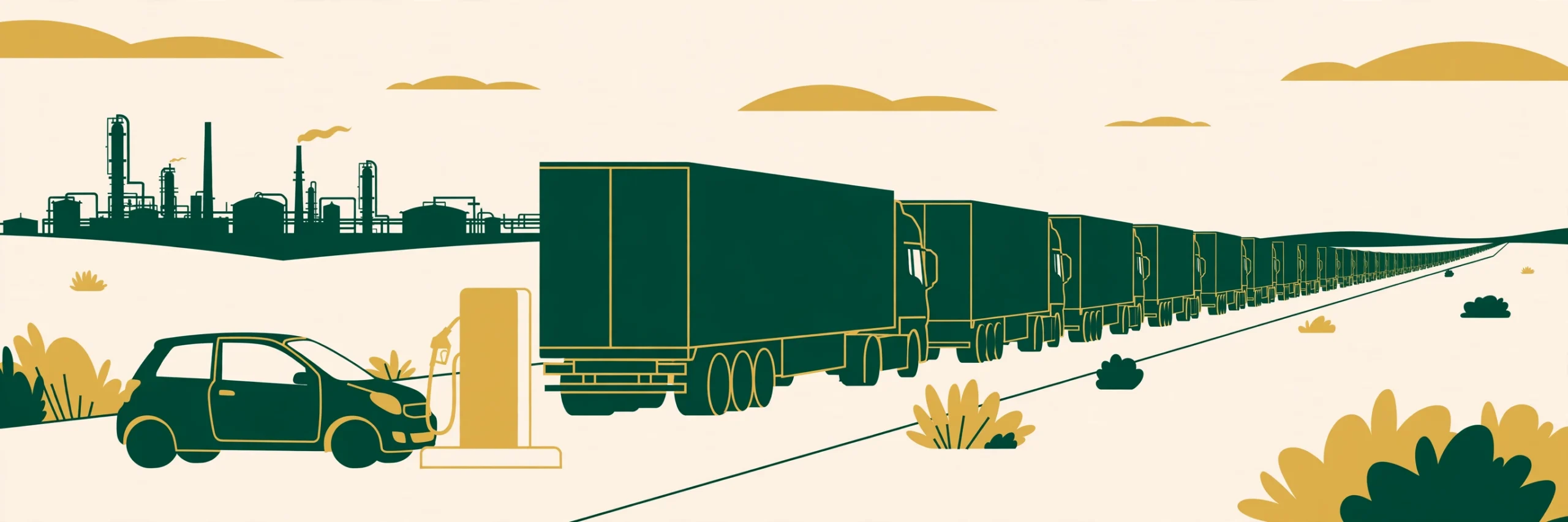
Oil is up roughly 60% since February, yet gas prices fell through October. The shock didn't skip American households — it changed address, into diesel, freight, and food.
5 min read
In October, oil and gasoline went in opposite directions.
Brent crude rose 13.6% in the month. The national average price of gasoline fell 19 cents — four weekly drops in a row, to $4.22 a gallon (AAA). A war around the Strait of Hormuz is still on, tankers are still being hit, and the price at the pump went down.
It is a strange picture, and it invites a comforting conclusion: that the oil shock somehow skipped American drivers. It did not. It moved.
The hit already happened
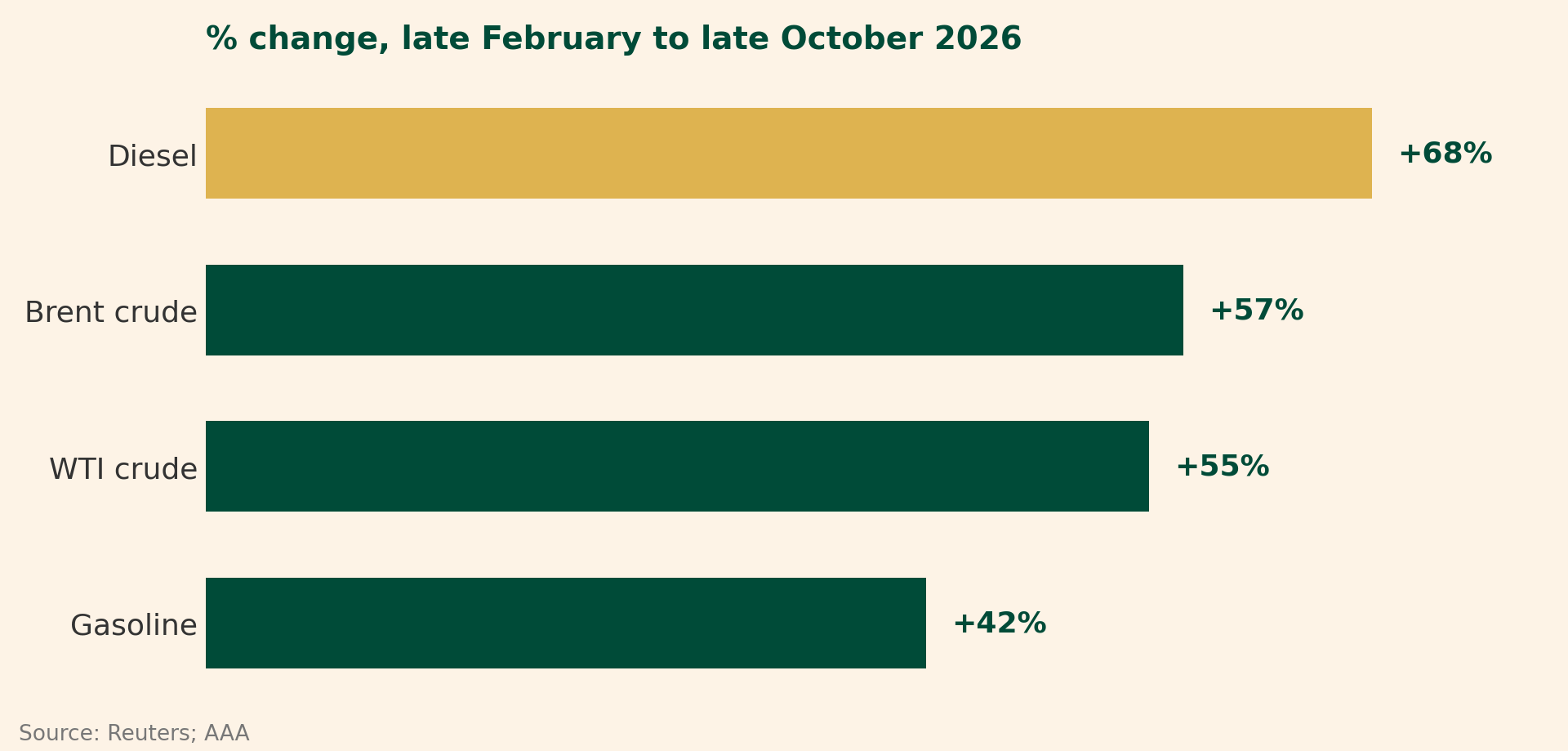
Start with the part that is easy to forget. Gasoline was $2.98 a gallon before the war. By May it was $4.56. It stayed above $4 for 158 straight days, a record, longer than the run in 2022. Even after October’s dip, a gallon costs 42% more than it did in February and 39% more than a year ago.
So drivers were not spared. They were billed early. Crude oil is only about half the price of a gallon of gasoline, and over the full stretch, pump prices actually rose more than the crude inside them. The October gap is a four-week story, not an eight-month one — and the reason for it sits in a refinery, not in the oil field.
Where the shock lives now
Follow the other fuel. Diesel hit $6.52 a gallon on September 22 — the highest price ever recorded in the United States. It has barely come down: about $6.33 in late October, up 68% since February, while gasoline was easing.
The bottleneck is refining. The Dallas Fed estimates 6 to 8 million barrels a day of the world’s fuel-making capacity is sidelined — up to a tenth of the global total — and the lost capacity is heavy in exactly the plants that make diesel. The margin for turning crude into diesel has run near $100 a barrel, about five times normal. The margin for gasoline did the opposite: roughly $58 a barrel in late August collapsed to about $21 by late October, as refiners switched to cheaper winter-blend fuel, gasoline stocks built by 3.9 million barrels in a single week, and demand dropped off.
That split explains the oil majors’ record quarter better than the crude price does. The five biggest majors made $56 billion in the third quarter, and the engine was refining, not drilling. Exxon Mobil’s refining business earned $9.05 billion — more than its oil and gas production arm, for the first time in at least six years. Chevron’s refining and marketing earned a record $4.93 billion, about four times a year earlier. The money in oil right now is not in owning crude. It is in owning one of the shrinking number of machines that can turn crude into diesel.
Why it still reaches your wallet
Diesel is the price inside everything else. Trucks, trains, and ships run on it, so when diesel stays at a record, the charge shows up quietly: airfares were up 22% from a year earlier in September (jet fuel is a cousin of diesel), freight costs are running about a fifth higher than a year ago, and the EIA expects households that heat with oil — common in New England — to pay about 21% more this winter. Moody’s chief economist Mark Zandi puts the war’s total added energy cost at roughly $1,100 per household.
Gasoline is the energy price Americans see every day, lit up on a sign. Diesel is the one they pay without seeing. This autumn, the visible price fell and the invisible one did not — which is why the shock can feel over at the pump and still be running through the grocery bill.
The outlook splits the same way. The EIA expects gasoline to keep easing, slipping below $4 in December. Diesel is a different forecast: the IEA expects supplies to stay tight well into 2027. If that holds, the sign on the highway keeps improving while the prices inside the store do not.
Winners
- Refiners — a shrinking club collecting record margins, with diesel near $100 a barrel over crude.
- The oil majors — a $56 billion quarter built on refining, with the cash going to debt and buybacks rather than new drilling.
- Drivers, briefly — four straight weeks of falling gasoline prices in the middle of an oil war.
Losers
- Truckers, farmers, and anyone shipping freight — diesel at records is a cost they cannot route around.
- Households that heat with oil — a winter bill the EIA expects to run about a fifth higher.
- Anyone watching the gas sign for the all-clear — the price that matters most right now is the one that does not have a sign.
⚡ Spark Takeaway: Crude makes the headline. Diesel makes the grocery bill. When the two split, believe the one inside everything else.
Sources: Reuters, October 30, 2026; AAA national average, October 29, 2026; U.S. Energy Information Administration; Federal Reserve Bank of Dallas, October 8, 2026.
KEEP READING
- The Spark Board — Brent and the national average, updated weekly, side by side.
- The AI Bubble Watch — the other big number the market is watching.
New posts by email
One short email when a new Financial Spark story publishes. No newsletter, no spam — unsubscribe anytime.