GDP grew 3.4% last quarter. In September, after inflation, the average paycheck bought less than the month before. Both numbers are true.
6 min read
THE SUNDAY EDITION
On Thursday morning at 8:30, the Bureau of Economic Analysis released two reports at exactly the same moment. Read together, they seemed to describe two different countries.
The first was excellent news. The economy grew at a 3.4% annual rate in the third quarter, up from 2.2% the quarter before. Businesses invested. Consumers spent. By the standards we usually apply, it was about as good a report as an economy produces.
The second report covered September, and it was quieter. Americans spent 0.5% more than they had in August. Prices also rose 0.5%. After inflation, households bought essentially what they had bought the month before — and real disposable income, the money actually available to spend or save, fell 0.3%.
Nobody made an error. The two reports measure different things. I keep coming back to the gap between them, because it seems to explain something I have heard all year: the economy is doing well, and very few people I talk to feel as though they are getting ahead.
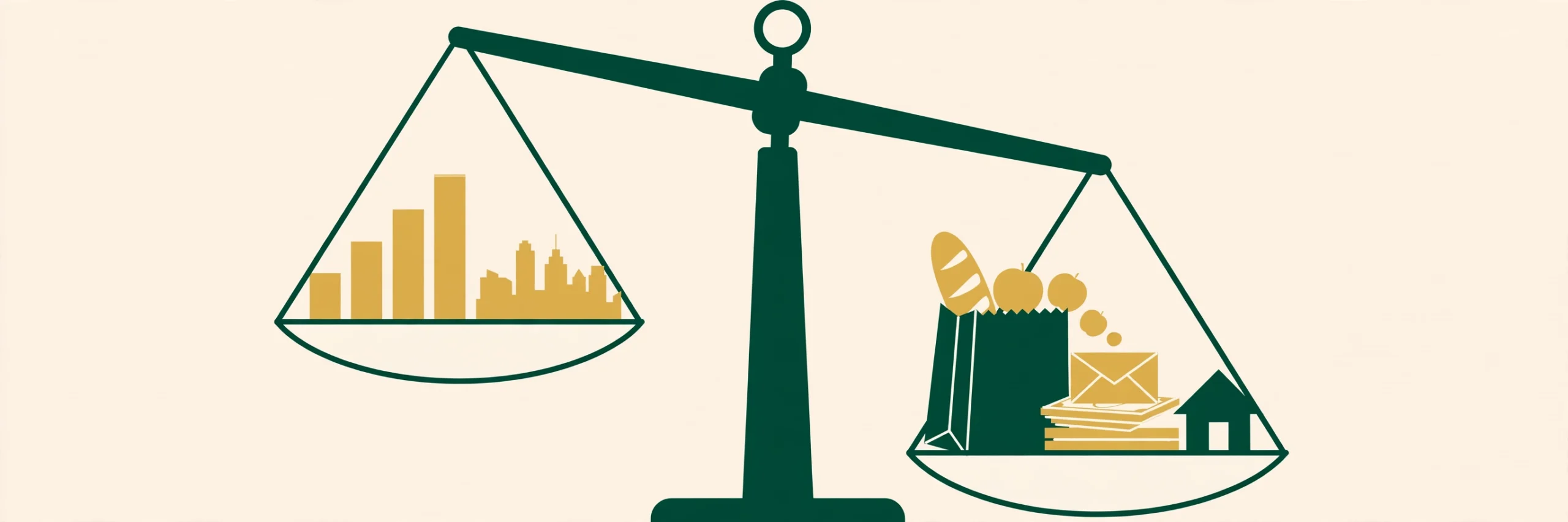
We have a habit of treating GDP as a national report card. A strong number means things are going well. A weak number means trouble. It is a tidy arrangement, particularly if your job involves summarizing a $30 trillion economy in a television segment.
Households keep a different set of books. They measure the economy by what remains after the mortgage, the groceries, the insurance and the utilities have been paid. GDP does not have a line for that.
To be fair, the strength in the third quarter was real. Consumer spending rose at a 3.8% annual pace, business investment was strong, and a broader measure — consumer spending combined with private investment — grew 4.9%. Those are not the numbers of an economy grinding to a halt.
But spending deserves a second look. Economists tend to read rising spending as confidence, and often they are right. Spending also rises when things cost more. Or when households save less. Or when standing still gets more expensive.
A family that spends $1,200 on the same groceries that cost $1,000 a year ago appears in the statistics as a healthy increase in consumption. The family experiences it somewhat differently. The economy records the additional spending. The family notices the missing $200.
September’s income figures were the softer part of the week. Disposable income rose 0.2% before inflation, and the saving rate stood at 3.8% — less than four cents saved out of every after-tax dollar.
One month is not a quarter, and I would not build too much on September alone. The growth figures cover three months; the income report covers one. Still, the direction is worth watching, because spending that persistently outruns income has only four possible endings: earn more, save less, borrow more, or spend less. Three of those four are not strategies so much as warnings.
What I find interesting is that Americans have not, on the evidence, given up on the economy. On Tuesday, the Conference Board reported that consumer confidence climbed to 91.7 in October, from 84.2 in September — a genuine improvement. The same survey found people still complaining, in considerable numbers, about the cost of food, groceries and energy.
I do not find that contradictory. You can feel reasonably secure in your job and still wince at the grocery bill. You can watch the value of your home climb while the cost of keeping it — insurance, taxes, repairs — climbs faster. You can have a retirement account performing beautifully and still do a double take at what dinner for four costs now.
The national averages combine all of those experiences into one tidy number. The people living them rarely feel average. A homeowner with a fixed-rate mortgage taken out years ago and a young family paying current rents are participating in the same economy, but not from the same seat.
There is also a quiet misunderstanding built into the way we talk about inflation. When officials say inflation is coming down, they mean prices are rising more slowly. They do not mean prices are returning to where they were.
Something that rose from $100 to $130 does not go back to $100 when inflation slows to 2%. It goes to $132.60.
The pace of the problem has improved. The price tag has not. Purchasing power recovers only when paychecks outrun prices for a while, and that takes time people can feel in the meantime.
This week offered little indication that the problem is finished. The PCE price index, the measure the Federal Reserve watches most closely, rose 3.6% in the year through September, up from 3.4% in August and still well above the Fed’s 2% target.
Which is the uncomfortable position the Fed now occupies. On Wednesday, it held interest rates at 3.75% to 4.00%. Two of its policymakers voted to raise rates on the spot. Growth is strong, inflation is too high, and nobody at that table wants 3.6% to become a habit.
The difficulty is that the standard cure lands on the same households already feeling the squeeze. Higher rates mean more expensive mortgages, car loans and credit cards. For a family whose income has just fallen behind prices, the medicine can feel remarkably similar to the illness — particularly when part of the pressure is coming from energy costs, which an interest rate cannot do very much about.
The next few months will tell us more than this week’s headline did. If income growth moves back ahead of prices, households will gradually recover some breathing room, and the strong business investment in these reports gives reason to think productivity may eventually help. If inflation stays where it is while income growth cools, spending will have to cool with it.
Nothing in this week’s numbers suggests anything like a collapse. Employment has held up, spending has proven durable, and the economy has absorbed an oil shock this year that would have flattened it in other decades. There is a tendency in economic commentary to insist that things must be either wonderful or terrible. At the moment, they are neither.
A country can become wealthier without every household in it feeling wealthier. That is not a contradiction in the data. It is the data.
Somewhere between a 3.4% growth rate and a 0.3% decline in real disposable income lies the difference between a strong economy and a household that actually feels better off. Most people do not need an economist to tell them which of those numbers gets read at the kitchen table.
— Greg Ranieri, Editor-in-Chief
Sources: Bureau of Economic Analysis, third-quarter 2026 GDP and September personal income and outlays, October 29, 2026; Federal Reserve policy statement, October 28, 2026; The Conference Board consumer confidence, October 27, 2026; Reuters, October 30, 2026.
KEEP READING
New posts by email
One short email when a new Financial Spark story publishes. No newsletter, no spam — unsubscribe anytime.