
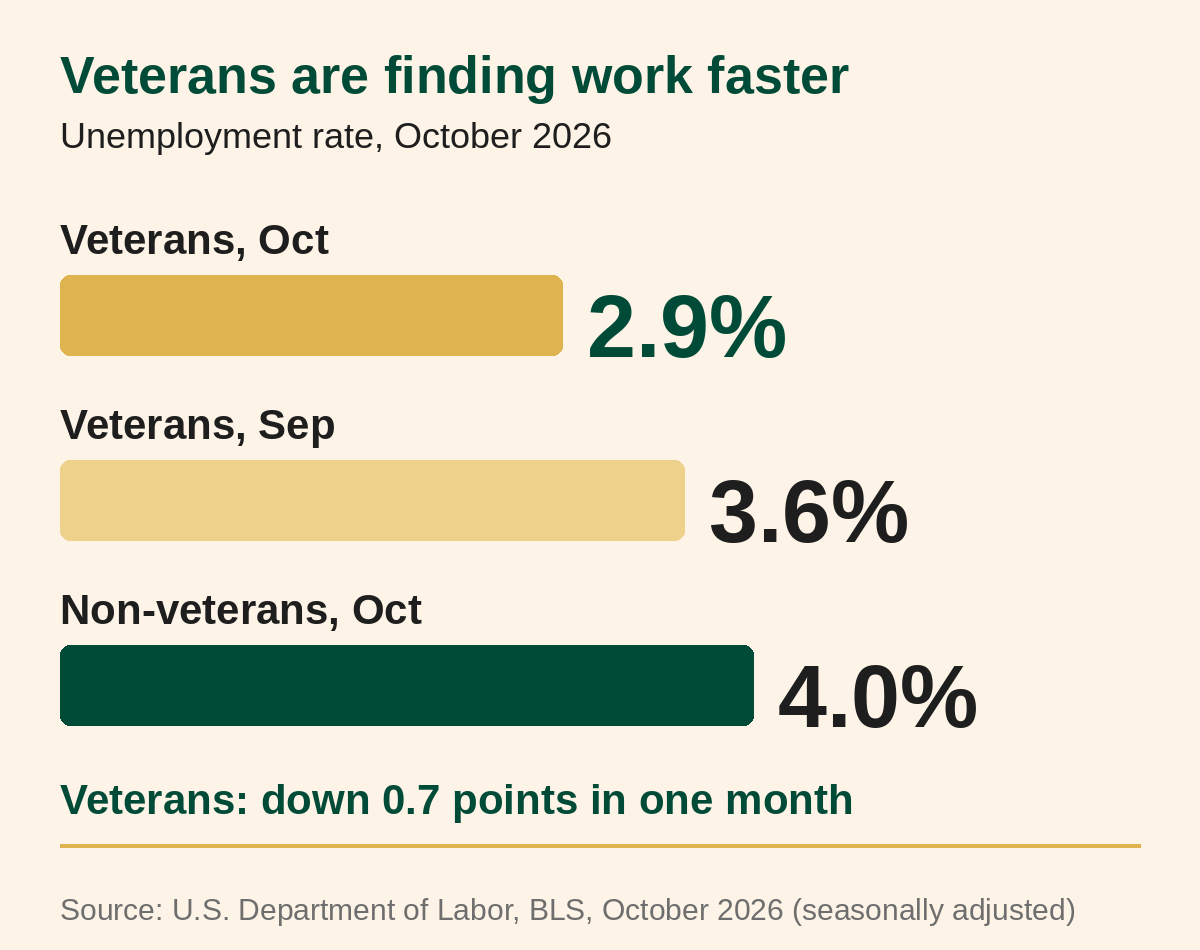
Veteran unemployment fell to 2.9 percent in October, well below the 4.0 percent for everyone else. The full table shows who is still being left behind.
5 min read
Today is Veterans Day. Before any numbers, the day itself deserves a sentence of its own: thank you to everyone who served, and to the families who served alongside them. The debt behind that thank-you does not fit in a jobs report. It is still worth checking what the jobs report says, because work is where the country keeps — or breaks — its side of the bargain.
The October figures, released Friday by the Labor Department, are genuinely good. Unemployment among veterans fell to 2.9 percent, down from 3.6 percent in September. The rate for non-veterans was 4.0 percent. Veterans are not merely keeping pace with a strong labor market. They are beating it by more than a full point.
A word on how the number is built, because that decides how much weight it can carry. The rate counts veterans who are working or actively looking for work, drawn from the same household survey behind the jobs report — the one this site covered Friday, when the economy added 165,000 jobs and overall unemployment eased to 4.1 percent. The headline veteran rate is seasonally adjusted, so October compares cleanly with September. Two figures further down — the post-9/11 rate and the disability rates — are published without that adjustment, so read their direction rather than their decimals.
The improvement reaches the youngest veterans. Unemployment among post-9/11 veterans fell to 3.4 percent, from 4.1 percent in September. That generation’s move from uniform to civilian work has been the hardest employment story of the past twenty years. At 3.4 percent, the move is working for most of them.
Now the counterweight, because an unemployment rate has a blind spot built into it. It only counts people still in the labor force. The share of veterans in the labor force slipped to 47.6 percent in October, from 48.1 percent in September. Some of that is demography, not discouragement: the veteran population is older than the workforce, many veterans are retired, and participation runs far below the 64.2 percent for non-veterans. An older population’s participation drifts down on its own. But a falling unemployment rate built partly on a shrinking labor force is a weaker kind of good news than one built on hiring alone. October had both — strong hiring, and a slightly smaller base.
The second gap is the one that should outlast the holiday. Across the year through October, veterans with a service-connected disability averaged 6.6 percent unemployment. Veterans without a disability averaged 3.3 percent. Exactly double. These are the veterans whose service cost them the most, and they face the hardest search for work that fits. The 2.9 percent headline does not reach them yet.
The money angle is not complicated. A job is the first line of every household budget — before the mortgage, before the savings rate, before any of the numbers this site usually tracks. For most veterans right now, that first line is filled in. For veterans with disabilities, and for the ones who have stopped looking altogether, it is not. That is where the distance between the headline and the whole table actually lives.
What to watch next: the November figures, due in early December. Two numbers decide whether October was a step or a blip — whether veteran unemployment holds below 3 percent, and whether participation stops slipping. The disability average moves slowly, so judge it across quarters, not months.
For today, the headline can stand. The country thanks its veterans every November 11. This year, the labor market is doing right by most of them. The ones it has not reached yet are in the same table — and a day set aside for gratitude is a good day to go looking for them.
Winners
- Veterans looking for work. A 2.9 percent unemployment rate, more than a full point below everyone else.
- Post-9/11 veterans. Their rate fell to 3.4 percent — the hardest transition in the workforce is landing.
- Veteran households. A paycheck steadies everything downstream of it, and more of them have one.
Losers
- Veterans with a service-connected disability. At 6.6 percent, their unemployment runs double the rate of veterans without one.
- Veterans who stopped looking. They leave the labor force, and the headline rate never sees them leave.
- The one-month verdict. The veteran survey sample is small and the rate swings — September to October is partly that swing.
⚡ Spark Takeaway: An unemployment rate counts only the people still looking. Honor the 2.9 percent — then check who it leaves out.
Sources: U.S. Department of Labor, Veterans’ Employment and Training Service, “Veteran Unemployment and Labor Force Participation Rates,” November 6, 2026; U.S. Bureau of Labor Statistics, Current Population Survey, October 2026; Military Times, “October surge in hiring lowers veterans’ unemployment to 2.7%,” November 6, 2026.
LISTEN TO THIS STORY
Marcus Bell reads his story, 5 minutes 24 seconds.
Listen on Apple Podcasts · Listen on Spotify · Subscribe in another podcast app
KEEP READING
- Household Debt Hit $19.1 Trillion. Read the Delinquency Number Twice. — the other side of the household ledger: what families owe, and how the late pile is counted.
- Americans Put September on the Card — Marcus Bell on the month credit card balances snapped back.
- The Market Watch — the follow-up list of companies the site’s own posts covered, each with one deciding number.
New posts by email
One short email when a new Financial Spark story publishes. No newsletter, no spam — unsubscribe anytime.