Credit cards did September's borrowing: revolving balances jumped $16.3 billion after falling in August, at a 22.36% rate. One month is not a trend. The price still matters.
5 min read
Consumer credit grew at a 6.4 percent annual rate in September, the Federal Reserve reported Friday — $27.8 billion added in one month, more than double the increase economists expected, for a total of $5.22 trillion. The headline is the total. The story is the mix.
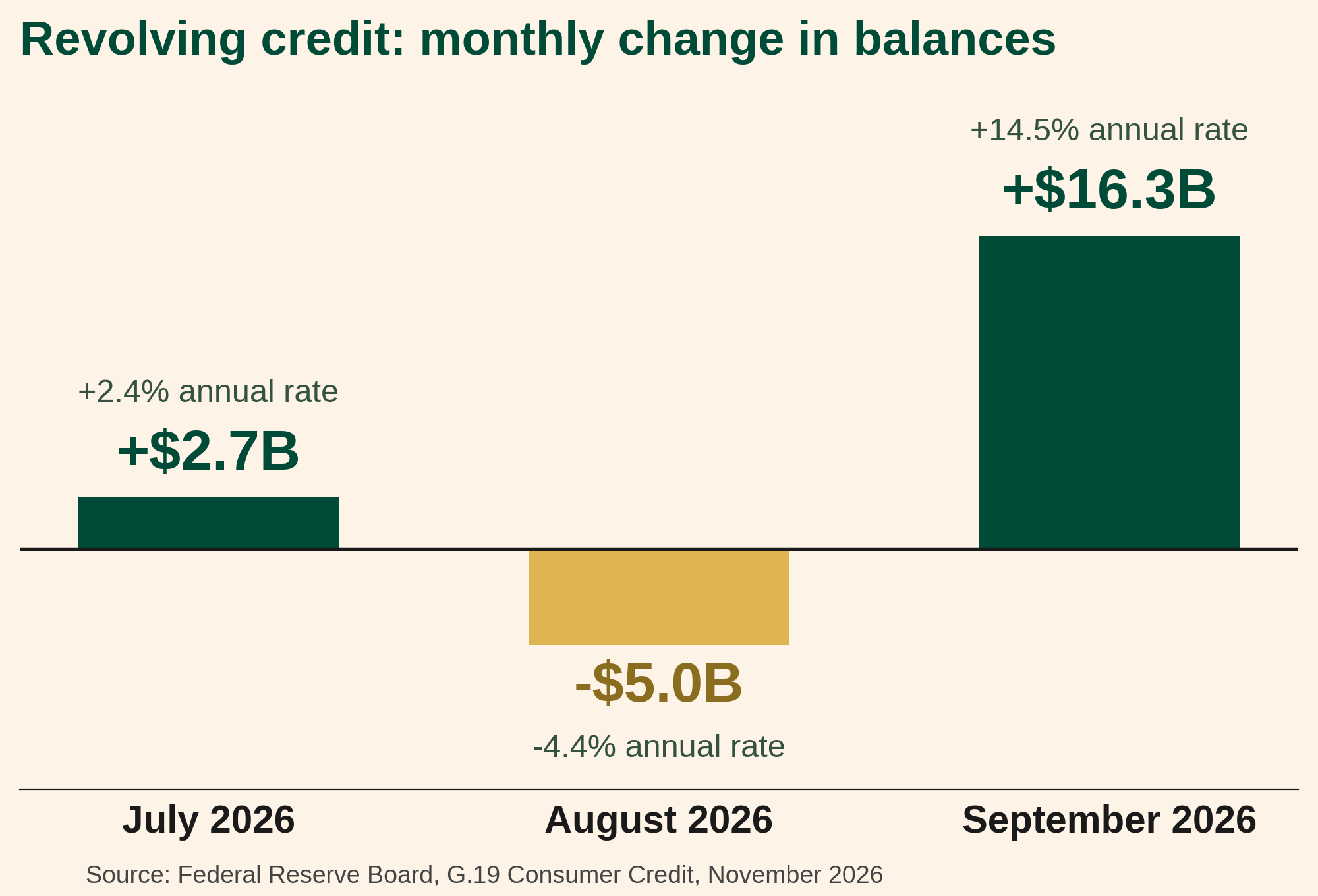
The report — the G.19 — leaves out mortgages and splits what is left in two. Nonrevolving credit is the scheduled kind: auto and student loans, fixed amounts paid down on a timetable. It grew at a 3.6 percent annual rate in September, slowing for a second straight month. Revolving credit is the other kind: credit you borrow, repay, and borrow again, the balance rolling month to month. In practice, revolving means credit cards. Card balances rose $16.3 billion in September, a 14.5 percent annual rate, after falling $5.0 billion in August. Balances now stand at $1.369 trillion. Revolving credit is about a quarter of all consumer balances. It supplied 58 percent of September’s increase.
Here is the constraint inside the number: the card sits on the most expensive shelf in the credit store, and the price on that shelf only creeps one way. The Fed’s latest reading on card terms — its August survey, the newest one in this release — puts the average rate on accounts actually charged interest at 22.36 percent, up from 22.15 percent in May. At that rate, every $1,000 a household carries costs roughly $224 a year in interest. The card is also the easiest credit to reach for in November and December. No application. No approval. No waiting.
That is the behavior this report really measures. A household smoothing a thin month, or starting the holiday spending early, rarely shops for the cheapest loan. It uses the credit already in its wallet. The G.19 cannot prove which motive drove September. It can show which shelf the borrowing came off.
Whether those households are falling behind is a separate question — the one yesterday’s household debt report took up. This report shows only the pace of the borrowing, and its price.
Now the honest case for shrugging at September. It is one month, and a jumpy one. Average the whole third quarter and revolving credit grew at a 4.1 percent annual rate — quick, not alarming. The 14.5 percent is a pace, not a month: September’s actual rise was about 1.2 percent, stretched to a year’s rate. The release revises itself, too. August’s figures arrived revised in this edition, and September’s are marked preliminary. And the G.19 counts dollars, not motives. The same $16.3 billion is confident shoppers starting the holidays early and stretched households covering groceries. The report cannot tell them apart. Neither can anyone reading it.
All of that is true, and the composition still matters. Whatever the motive, September’s borrowing was financed at the card rate, and it lands in the same quarter as the year’s heaviest spending. A month borrowed at installment rates is a footnote. A month borrowed at 22.36 percent leaves something behind: balances still growing at 22 percent when January’s bills arrive.
What to watch next: the October G.19, due in early December. Two readings would settle what September was. A second straight month of fast revolving growth turns a snapback into a pattern. A revision cutting September’s 14.5 percent toward the quarter’s 4.1 percent pace turns it into a blip. Until then, the month’s lesson is about price, not panic.
Winners
- Card issuers. Balances up $16.3 billion in a month, at rates above 22 percent. The expensive shelf is a good shelf to own.
- Retailers. September’s swipes were the holiday season starting early — financed, and already in the register.
- Households that pay in full. They get the float and the points, and the 22.36 percent never touches them.
Losers
- Households that revolve. September’s balance meets December’s spending at 22.36 percent, and January gets the bill.
- The scheduled-loan business. Nonrevolving growth slowed to 3.6 percent, a second straight step down. When households borrow fast, they skip the timetable.
- The one-month headline. September is preliminary, October will argue with it, and both the panic and the victory lap were written off a number the Fed has not finished with.
⚡ Spark Takeaway: The pace of borrowing is weather. The shelf it comes off is climate. September’s borrowing came off the most expensive shelf in the store.
Sources: Federal Reserve Board, Consumer Credit — G.19, September 2026 (released November 6, 2026), seasonally adjusted percent-change, flow, and levels tables, and the terms-of-credit table (August 2026 survey); Bloomberg survey of economists, September 2026 consensus, via same-day coverage (November 6, 2026).
LISTEN TO THIS STORY
Marcus Bell reads his story, 6 minutes 22 seconds.
Listen on Apple Podcasts · Listen on Spotify · Subscribe in another podcast app
KEEP READING
- Household Debt Hit $19.1 Trillion. Read the Delinquency Number Twice. — yesterday’s companion piece: whether borrowers are falling behind, and why the Fed’s two delinquency measures disagree.
- The Market Watch — the follow-up list of companies the site’s own posts covered, each with one deciding number.
- The AI Bubble Watch — the standing scoreboard on the market’s biggest risk; household borrowing is the other side of the same consumer.
New posts by email
One short email when a new Financial Spark story publishes. No newsletter, no spam — unsubscribe anytime.