The ground stop lasted four hours. The squeeze behind it has lasted all year — fuel at twice the price, no hedges, no slack. Friday, both bills came due.
9 min read
🔥 FinancialSpark
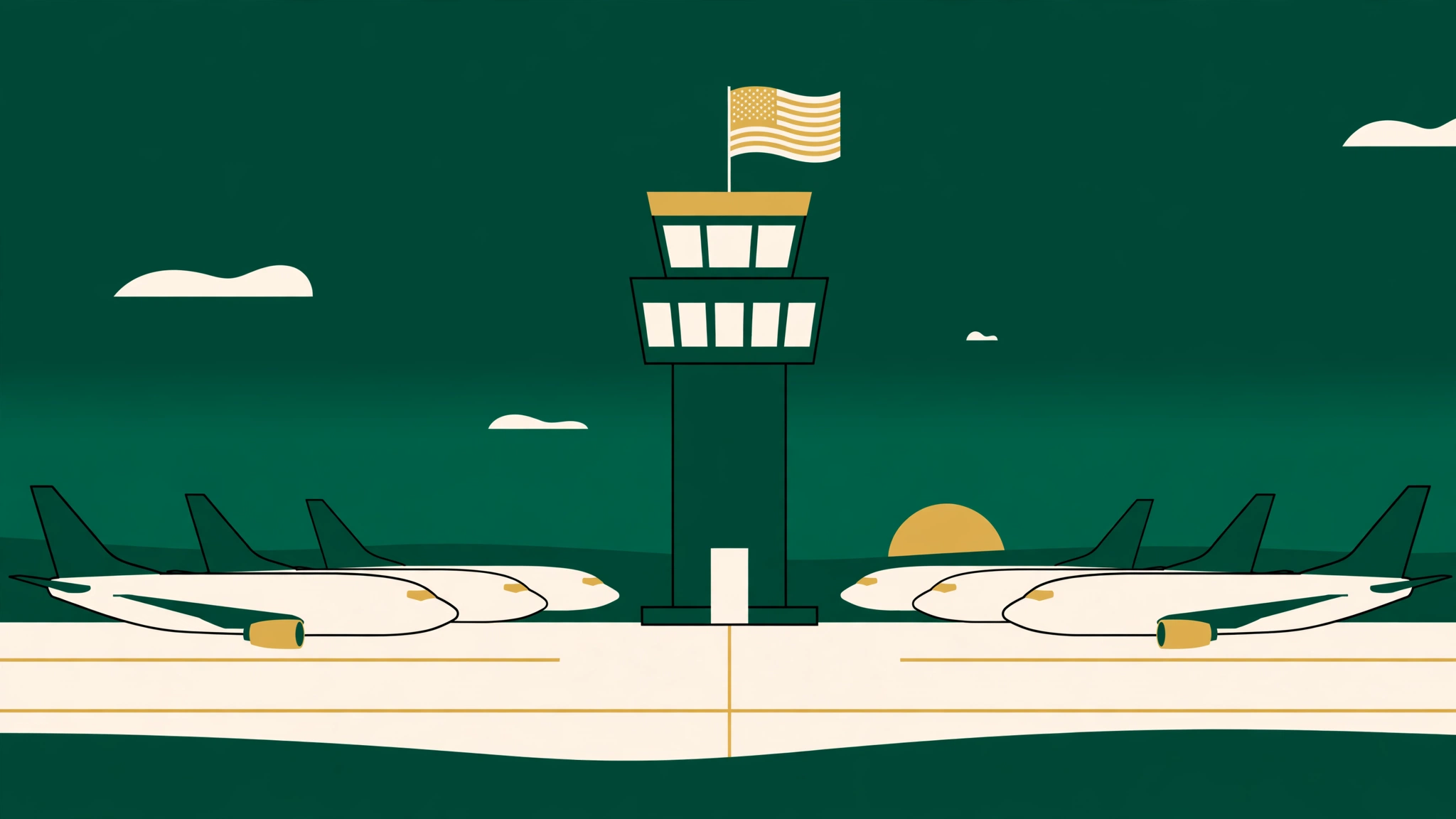
At 3:54 p.m. on Friday, the Federal Aviation Administration did something it has done only once before since September 11, 2001. It ordered every departing flight in the United States to stay on the ground.
The stop ran until 8:15 p.m. Four hours and twenty-one minutes with no takeoffs, anywhere in the country. The Associated Press called it the longest nationwide ground stop in 25 years.
What broke
The trouble started around 3:36 p.m., when communications at the FAA’s Air Route Traffic Control Centers — the facilities that guide planes between airports — grew unstable. Transportation Secretary Sean Duffy blamed switches and routers in the aging network, overloaded with data. Administration officials told AP that new technology being added to the system overwhelmed the antiquated equipment underneath it, causing intermittent communications and radar gaps.
Homeland Security Secretary Markwayne Mullin said there was no indication of a cyberattack. More than 3,000 flights already in the air landed safely.
By Friday night, FlightRadar24 had recorded more than 6,600 flights canceled and 8,600 delayed. Cirium, the aviation data firm, counted roughly 11,000 flights carrying more than 1.5 million passengers scheduled to depart after 4 p.m. — the Friday evening rush, the worst hour of the week to fail. Another 827 flights were diverted. On Saturday, airlines canceled more than 2,500 additional flights, by FlightAware’s count via AP, while aircraft and crews sat in the wrong cities.
An industry with no slack left
The stop ended at 8:15 p.m. The airlines’ problem did not.
An airline schedule is a chain. The plane that lands in Chicago tonight is the plane that leaves for Denver in the morning, and a crew sleeping in the wrong city cannot fly again until it has rested. Snap the chain in fifty cities at once, and putting it back together takes days, not hours.
American said Friday night it was prioritizing flights to smaller cities outside its major hubs, and international flights, specifically to get aircraft and crews back into position for a faster recovery. Even so, 1,500 flights were already canceled for Sunday by Friday night, by FlightRadar24’s count, and aviation analysts said the disruption could run for days. Duffy warned that departures would resume gradually and normal operations would take time to restore. Officials expect the system back to normal in time for the Thanksgiving travel rush.
Now place that weekend on top of the year the airlines have already had.
Nine months into the Iran war, jet fuel costs roughly double what it cost before the war. Fuel is 30 to 40 percent of an airline’s total costs. There is no version of that arithmetic that stays small.
The usual cushion is gone, too. American, United, Delta, JetBlue and Allegiant carry no material fuel hedges — the contracts that lock in a fuel price in advance — and Southwest ended its long-running hedging program last year. U.S. airlines largely gave up the practice years ago, so the war’s fuel price lands directly on the income statement, unfiltered.
It is already showing. In October, Delta, United and Southwest all cut profit targets or disappointed investors with their outlooks as fuel expenses climbed. U.S. airfares were up more than 20 percent from a year earlier in September — the industry handing the fuel bill to passengers, and testing how much more of it they will pay.
So Friday’s failure hit an industry with no slack left, through a system with no slack left. The recovery costs — passengers rebooked, crews and aircraft put back where they belong, a weekend of flying that will never be resold — land on airline operations, not on the agency whose equipment failed. The one protection the airlines have is a legal one: because the failure was the government’s, U.S. carriers are not required to compensate stranded passengers beyond refunds.
What did the weekend cost the airlines, in dollars? Nobody knows yet, and any precise figure quoted this weekend is a guess. The estimates circulating are models built on industry benchmarks, not losses any carrier has reported. The direction is the only certainty: an unplanned, unbudgeted cost, arriving in the most expensive fuel year the industry has had in recent memory.
The bill was already written
Here is the detail that tells the story. The request to fix the system went to Congress on Friday morning — hours before it failed.
Duffy and White House budget director Russell Vought asked lawmakers for $30.1 billion to upgrade the nation’s air traffic control system and airports. That sits on top of the $12.5 billion Congress approved in July 2025. Together, the program on the table Friday morning totaled $42.6 billion.
The $30.1 billion breaks down plainly: $10.1 billion for air traffic control modernization, including $7.2 billion for a common automation platform and controller workstations and $2 billion for cloud computing; $2 billion to replace and improve control towers; and $18 billion for airport projects, $10 billion of that for aging terminals.
By Friday night, with the backlog still clearing, the number had moved. Duffy called the situation an emergency, and the administration raised its request to $50 billion.
Think of it the way a plant manager would. Maintenance you skip does not disappear. It moves to a different ledger — the one that charges interest in downtime.
The FAA still moves weather and other critical information on floppy disks at more than 400 facilities, with retirement planned by the end of 2028. It has bought spare parts for decades-old computers through auction websites. The overhaul already under way has replaced 68 percent of the old copper telecommunications network with fiber.
What Friday does not prove
The counterweight matters, because a bad afternoon is not the same as a broken sky.
Nobody was hurt. The safety logic underneath the failure worked exactly as designed: planes in the air landed, planes on the ground stayed put, and departures resumed the same evening. The only other nationwide stop since 9/11, in January 2023, lasted less than two hours.
The airlines will recover on schedule, too. A four-hour stop, however ugly, is a bad weekend — it is not the fuel bill, which arrives every single day and does not care about headlines. Friday will be a footnote in the carriers’ quarterly numbers long before the war’s fuel price is.
Money alone is not the fix, either. Congress has already approved $1.9 billion aimed at replacing the outdated en route centers — the facilities that failed on Friday. The Senate Commerce Committee is already arguing that new money should go to those centers first, not to airport terminals.
What four hours did prove is narrower, and worse: the system has no margin, and neither does the industry flying through it. The certain costs are the visible ones: more than 9,000 canceled flights across two days by the trackers’ counts, a recovery still running into Sunday, and a modernization ask that grew by roughly $20 billion between the morning’s letter and the evening’s briefing.
Winners and losers
Winners
- The modernization builders. A $7.2 billion automation platform, new towers, a cloud migration: a decade of contracted work, now with an emergency attached to it.
- The airlines’ case in Washington. American, Delta, United and Southwest had already backed the funding request on Friday morning. By Friday night, they no longer needed to make the argument. The outage made it.
- Travelers, eventually. If the rebuild lands, the system that failed on Friday is the one scheduled to disappear. The benefit is real, and years away.
Losers
- Passengers with Friday or Saturday plans. More than 1.5 million people were booked on flights scheduled to depart after 4 p.m. on Friday alone — and because the failure was the government’s, their remedy is a refund, not compensation.
- The airlines, twice over. Fuel at twice the pre-war price, no hedges, profit targets already cut — and now a recovery bill for a failure that was not theirs, collected in their most expensive year.
- The pay-as-you-go approach itself. Every year of delay repriced the fix. The $12.5 billion approved last year was the down payment. Friday set the interest rate.
⚡ Spark Takeaway: Deferred maintenance is debt you never voted on and never signed — and slack is the only thing that ever pays it down early. The FAA ran out of both on Friday. The airlines, their fuel cushion gone in a war year, were already running on empty. Four hours collected the two debts together.
Sources
- Reuters, “US grounds flights nationwide after air traffic control communications outage” (Nov 13, 2026) — the ground stop, the $12.5 billion approved, the $30.1 billion request, the January 2023 comparison, American’s recovery positioning, the 1,500 Sunday cancellations (FlightRadar24), analysts on days of disruption, and no compensation owed to passengers for a government-caused failure.
- Reuters, “Trump official seeks $50 billion for air traffic control after outage” (Nov 14, 2026, via The Hindu BusinessLine) — the $30.1 billion breakdown, the raise to $50 billion, the $1.9 billion for en route centers, floppy disks at 400+ facilities, 68 percent of copper replaced with fiber.
- Reuters, “As Iran war drags on, airlines pull back on fuel hedges and warn on fares” (Oct 28, 2026) — jet fuel at roughly double pre-war levels nine months into the war, fuel at 30–40 percent of airline costs, no material hedges at the U.S. majors, Delta/United/Southwest profit-target cuts, U.S. fares up more than 20 percent year on year.
- Associated Press, “Thousands of flights canceled as airlines work to dig out from nationwide ground stop” (Nov 14, 2026) — more than 2,500 Saturday cancellations (FlightAware), 3,000+ flights landed safely, no indication of a cyberattack, 827 diversions (Cirium), disruption felt for days with normal operations expected by the Thanksgiving rush.
- FlightRadar24 counts (6,600+ canceled, 8,600 delayed on Friday) and Cirium schedule data (roughly 11,000 flights, 1.5 million passengers after 4 p.m.) as reported by Reuters and AP.
LISTEN TO THIS STORY
Claire Donovan reads her story, 10 minutes 47 seconds.
Listen on Apple Podcasts · Listen on Spotify · Subscribe in another podcast app
KEEP READING
- The Housing Market Didn’t Crash. It Froze. — another system that did not break; it stopped moving, and the arithmetic explains why.
- The $2 Trillion Hope Became a $1 Trillion Ask — the week’s other giant number, moving in the opposite direction.
New posts by email
One short email when a new Financial Spark story publishes. No newsletter, no spam — unsubscribe anytime.