

Is AI a bubble? Nobody knows, and anybody who gives you a date is selling something.
What we can do is watch the numbers that would tell us. This page keeps score.
The unravel clock
This page’s one extrapolation. It is a ruler, not a crystal ball.
Take today’s rates and run them forward. Spending grows 30% a year — about the pace the big four just set. The AI revenue they have disclosed doubles every year — generous, and roughly the growth Microsoft and AWS just reported.
Run both lines. They cross on September 28, 2031.
By then, about $8.7 trillion will have gone out the door.
That date is the deadline on the bet. The revenue has to keep doubling, every year, for five years, just to arrive. If it stumbles, the thing that gets cut is the spending — and the stocks priced for the spending follow.
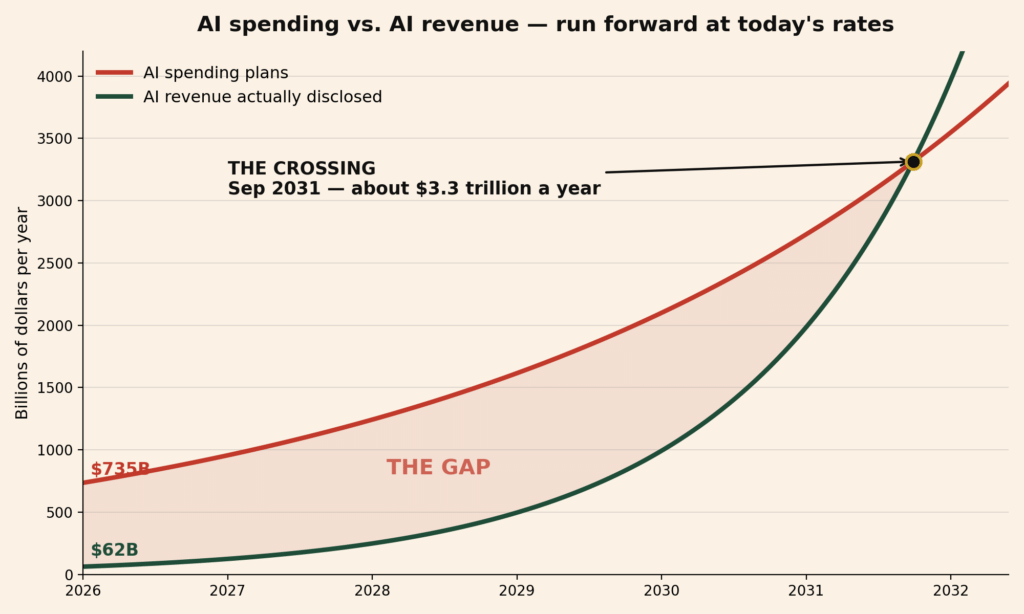
We reset the clock after every earnings season, when real numbers replace the guesses. Good quarters pull the date closer. Bad ones push it out. One path — spending up 40%, revenue up 60% — pushes the crossing to 2044 and $900 trillion of cumulative spending. That is the math's way of saying that path breaks long before it gets there.
The spending
The big four — Microsoft, Alphabet, Meta, and Amazon — now plan to spend $725 to $745 billion on capital projects in 2026, most of it AI data centers.
- Microsoft: about $175 billion
- Amazon: about $220 billion
- Alphabet: $195 to $205 billion
- Meta: $135 to $145 billion
That is about $23,000 every second.
The other side of the ledger
Now the revenue — the AI money they have actually put a number on.
- Microsoft: a $37 billion annual run rate. Announced in April. Not updated since.
- Amazon's AWS: an AI run rate above $25 billion, as of July.
- Alphabet: no number. Meta: no number.
Add up every AI revenue figure the big four have put on the record and you get about $62 billion — against $725 billion of planned spending.
That does not prove a bubble. It does measure the faith.
And the company at the center of it, OpenAI, is private. Reports put its revenue run rate anywhere from $50 to $70 billion, depending on who is counting. Even the fog has fog.
The counterweight: most of this spending is paid out of enormous existing profits, and the cloud business is real — Google Cloud revenue rose 82% in the second quarter. Bubbles are usually built on borrowed money and no revenue. This one is built on real money chasing revenue that has not shown up yet. That is different. It is not necessarily safer.
The gauges
The market's price tag — CAPE ratio 40.4. Investors are paying about $40 for every $1 of the market's long-run average earnings. The long-run average price is about $17. The only time it was higher was December 1999: 44.2. (As of October 23, 2026.)
Concentration — the top 10 stocks are 39.2% of the S&P 500. Ten companies carry nearly two-fifths of the index. When they move, "the market" moves. (As of September 30, 2026.)
The next test
Wednesday, October 28: Microsoft and Alphabet report earnings after the close — the same day the Federal Reserve announces its rate decision. Amazon follows Thursday.
Meta already took its test on October 21. It raised its spending plans, and the stock fell 5%.
A bubble is not a price. It is a gap between what has been spent and what has been shown. Watch the gap.
The AI Bubble Watch is updated weekly by the Financial Spark staff. Figures as of October 24, 2026. Sources: Reuters, Associated Press, company earnings reports, multpl (Shiller data), S&P Dow Jones Indices data.