Anthropic's record IPO starts trading today. If you own an index fund, you are already in line to buy it — at whatever price the market sets.
8 min read
Anthropic priced its stock sale last night at $83 a share, above the $70 to $78 range it had marketed. The sale raised $81.3 billion — the largest initial public offering on record — and values the maker of the Claude chatbot at about $1.5 trillion. Trading starts today on the Nasdaq, under the ticker ANT.
You probably did not buy any.
That will not matter.
The purchase you did not make
Most Americans do not own stocks one at a time. They own index funds, often inside a 401(k), and index funds do not get to have opinions. When a company joins the index, the fund buys it — at market weight, at whatever price the market has set by then.
Anthropic will not wait long to join. A Nasdaq rule written in May, ahead of SpaceX’s debut, fast-tracks any new listing big enough to rank among the Nasdaq-100’s 40 largest companies: tested on its seventh trading day, added after about fifteen. The December reshuffle calendar puts ANT’s entry at the open on Monday, December 21, by Bloomberg’s reading of the rules. The broad-market indexes move faster: FTSE Russell’s fast-entry rule places an IPO of this size after its fifth day of trading. Intropic, a firm that tracks index rebalancing, estimates index funds will buy roughly $19 billion of Anthropic stock — buying that never asks whether the price makes sense.
The S&P 500 is the holdout. Its rules demand a year of trading and actual profits, and a committee decides; in June, S&P Dow Jones Indices said those rules would stay, naming SpaceX, OpenAI and Anthropic. So whether your retirement account bought the biggest IPO in history depends on which fund your employer’s plan happens to hold.
Small door, big room
The honest arithmetic starts small. Only 980 million shares were sold — about $81 billion of stock that actually trades, against a $1.1 trillion company. Index weight follows the shares that trade, so Anthropic starts at roughly a tenth of one percent of the U.S. market’s value. Then the lockups expire — insiders held up to 180 days, the founders up to a year — and more shares float.
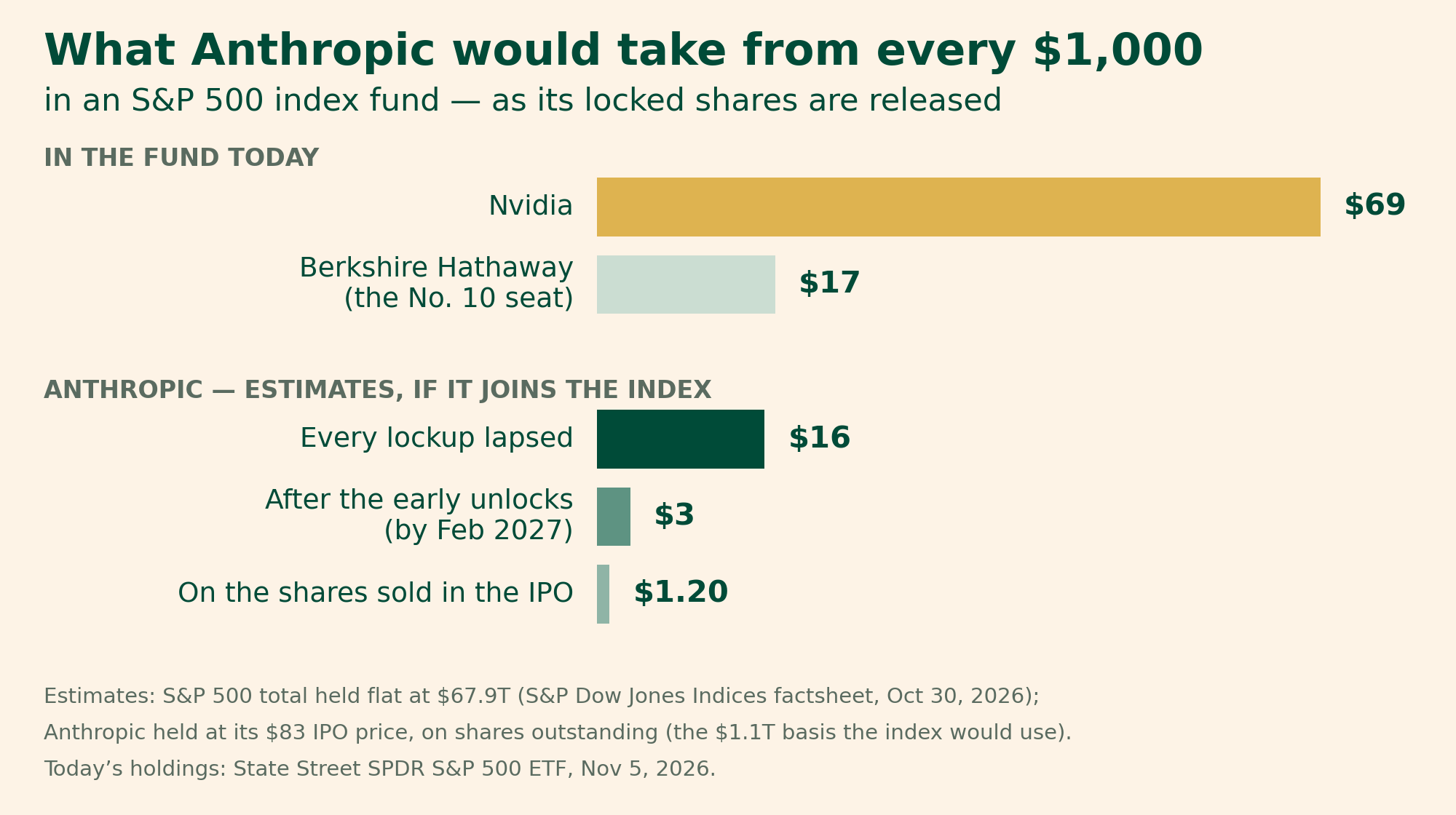
Put it in dollars. On the shares sold in the offering alone, Anthropic would start at about $1.20 of every $1,000 in an S&P 500 fund — roughly No. 150 in the index, a rounding error with a ticker. Run the lockup staircase the prospectus lays out — up to 1.6 billion more shares become eligible to trade by early February — and the slice grows to about $3. Let every lockup lapse, and count the company the way the index will, on the 13.3 billion shares that exist rather than the options and restricted stock folded into the $1.5 trillion headline, and the slice lands near $16: about 1.6 percent of the index, one seat outside the top ten, between Berkshire Hathaway and Tesla. None of it is a forecast — the index’s total value and the $83 price are frozen to show the mechanics, and the S&P 500’s committee still has to say yes — but the direction is not in doubt: the door is small, and the room behind it is Berkshire-sized.
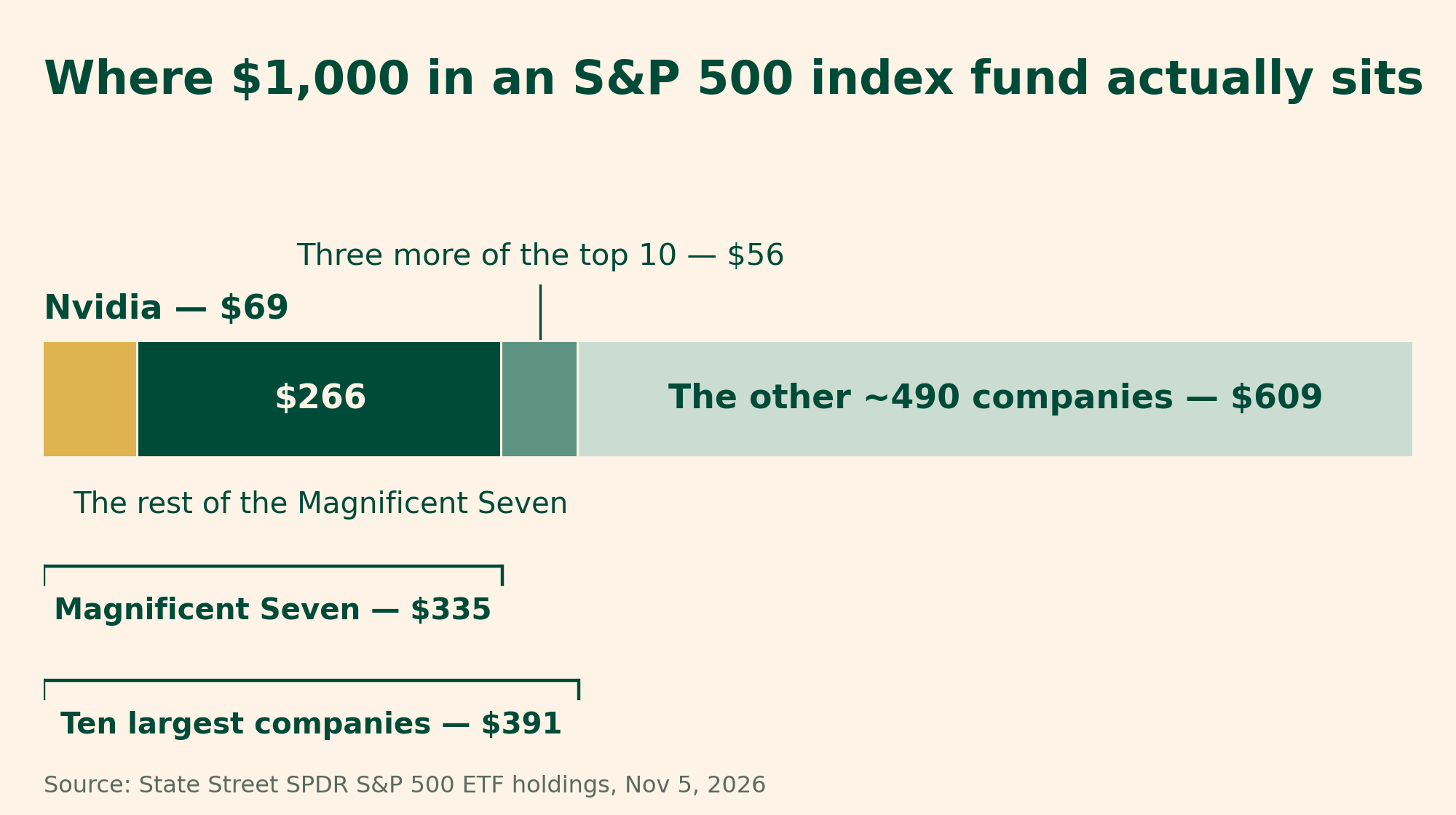
It lands on an index that is already top-heavy. The ten largest companies were 39.1 percent of the S&P 500 on November 5; the Magnificent Seven alone were 33.5 percent — $335 of every $1,000 in an index fund. Nvidia, one chip company, was 6.9 percent: $69 of that $1,000, more than the entire energy sector and the entire utility sector combined. Goldman Sachs counts AI-linked companies at about 45 percent of the index’s value, and estimates the seven largest stocks will deliver 46 percent of its earnings growth in 2026.
The exposure does not stop at the tech names. Microsoft, Alphabet, Amazon and Meta have guided to roughly $730 billion of capital spending in 2026, most of it for AI data centers. That money lands on index members far from Silicon Valley: Constellation Energy and Vistra, utilities holding 20-year nuclear power deals with the hyperscalers; GE Vernova, with a $176 billion order backlog. Anthropic itself has committed nearly $900 billion to computing capacity, owed mostly to Amazon and Google — which also bought into its $26 billion private placement. Your utility stocks are AI stocks now. The layer underneath is easier to miss. CoreWeave and Nebius rent out the chips themselves, a line of business that barely existed five years ago, and in June both joined the Nasdaq-100 — at 0.10 and 0.15 percent of that index — carrying contracted backlogs of about $99 billion and $50 billion. Inside the S&P 500, Vertiv sells the cooling and power gear every data center needs; it joined the index in March, and its third-quarter revenue rose 61 percent, to $4.31 billion. Arista, which sells the networking that ties the clusters together, holds another 0.31 percent of the index. And there is no leaving the country to escape it: the United States was 64.6 percent of the MSCI All-Country World Index on October 30. A “world” fund is two-thirds America, topped by the same names.
The queue behind it
This has already happened once. SpaceX went public in June, raising $75 billion at a $1.77 trillion valuation, and entered the Nasdaq-100 on July 7. OpenAI is next: it filed confidentially in June, its chief executive has ruled out 2026, and Reuters reports it is eyeing a 2027 listing. Its last closed private round valued it at $852 billion; October reports put its current talks above $1.4 trillion. Add the three together — SpaceX near $1.9 trillion today, Anthropic at $1.5 trillion, OpenAI at a reported $1.4 trillion — and roughly $4.8 trillion of company value is entering, or waiting to enter, the same indexes in about a year. Bank of America’s Michael Hartnett estimates AI companies could reach 48 percent of the U.S. market’s value once all three are public.
None of this makes index funds a bad idea. They remain the cheapest, most dependable way most people own stocks, and Anthropic is not a shell: third-quarter revenue grew 47 percent, to $16.96 billion, and its annualized run rate hit $81 billion on October 31. The S&P 500’s refusal to fast-track anyone shows the gates are not all automatic. SpaceX, five months after its debut, trades barely above its $135 offering price — the market does reprice these names.
But notice who made the decision.
What if the largest position decisions in your retirement account are now made by a rulebook — one that buys whatever is biggest, at whatever price, on a date printed in advance?
That is market-cap weighting in a mega-IPO era. Indexing feels like having no opinion. In practice it is an opinion, executed automatically: the biggest slice of your money always goes to the most expensive companies, and each record IPO makes the slice bigger. The only choice that stays yours is how much of your savings sits in funds that work this way. It is a real choice. It just has to be made before the index makes it for you.
Winners
- Anthropic’s early backers and employees — a private valuation becomes public, with index funds queued as buyers who cannot say no.
- Power and equipment suppliers — Constellation, Vistra and GE Vernova collect the $730 billion build-out whichever model company wins.
- Savers who wanted AI exposure without picking stocks — they have it now, in size.
Losers
- Anyone who heard “index fund” and pictured money spread evenly — $391 of their $1,000 rides on ten companies.
- The other 493 — index funds pay for the new giants by trimming everything else they hold.
- Diversification itself — when a world fund is two-thirds one country and nearly half one theme, the word does less work than it used to.
⚡ Spark Takeaway: An index fund is not the absence of a bet. It is a bet that sizes itself — and in the mega-IPO era, it sizes itself into whatever just went public, at whatever price, whether you would have or not.
Sources: Reuters, November 18–19, 2026; Nasdaq-100 methodology (fast entry, effective May 1, 2026); FTSE Russell index ground rules, November 2026; State Street SPDR S&P 500 ETF holdings, November 5, 2026; Global X QYLD holdings, November 10, 2026; S&P Dow Jones Indices, March 2026; Goldman Sachs estimates; MSCI index factsheet, October 30, 2026; S&P Dow Jones Indices S&P 500 factsheet, October 30, 2026; Anthropic Form S-1/A, November 10, 2026; Morningstar.
LISTEN TO THIS STORY
Daniel Reyes reads “The Biggest IPO in History Is Headed for Your 401(k)” — 10:20.
Listen on Apple Podcasts · Listen on Spotify · Subscribe in another podcast app
KEEP READING
- The AI Bubble Watch — the gauge tracking how stretched the AI trade has become.
- The Spark Board — the eight numbers that steer everyday money, updated daily.
New posts by email
One short email when a new Financial Spark story publishes. No newsletter, no spam — unsubscribe anytime.