Nvidia's board is investigating its CEO. The stock's 5 percent fall says less about the probe than about a market flipped from FOMO to FOGO.
4 min read
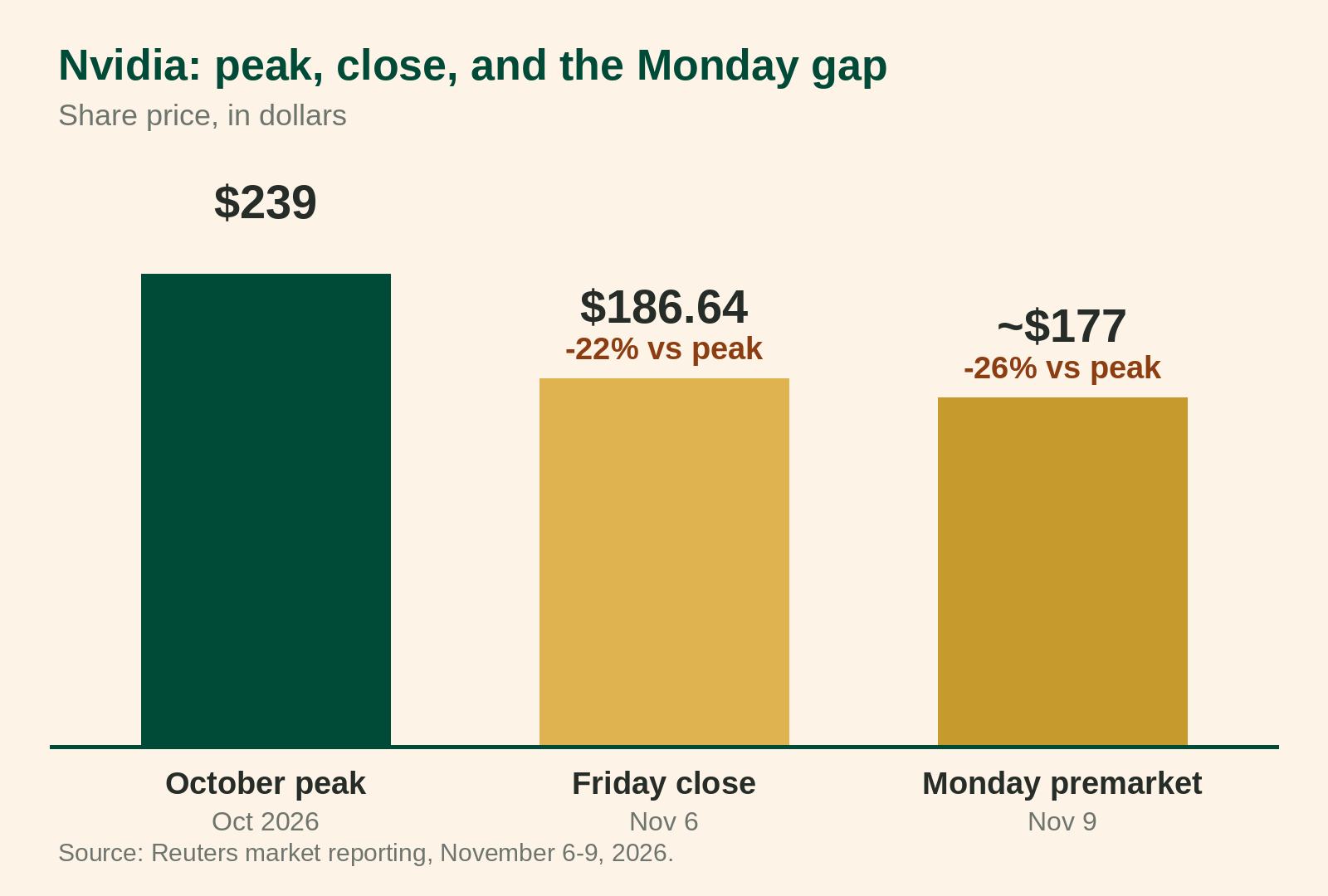
The market’s verdict arrived before the facts did. Nvidia fell 4 to 5 percent before Monday’s opening bell and more than 6 percent in Frankfurt, putting roughly $270 billion of market value in play. The trigger was not earnings. It was an investigation into the chief executive. It closed Friday at $186.64, down 22 percent from its October peak, flat for the year.
On Sunday, the board said a committee of independent directors, working with outside lawyers, will investigate reports that CEO Jensen Huang was targeted by a foreign-intelligence effort. The New York Times reported on October 29 that US authorities had concluded Alice Huang, a former Megaspeed executive and no relation, was a Chinese intelligence asset. Huang told staff he had been unfaithful to his wife. The board said it has “no reason to believe” national security or Nvidia’s secrets were compromised. Nothing is proven, nobody has been charged, and China calls the story groundless.
Why does an unproven allegation cost 5 percent? Start with the mood. Elliott Investment Management coined the term in its October letter: FOGO — fear of getting obliterated. Elliott warned that nearly every historical bear-market alarm is sounding, and that leverage can flip the mood in an instant: a small decline wipes out anyone who bought with borrowed money. Bloomberg gave the word a market after Thursday’s selloff. Shuli Ren’s column and the Big Take podcast describe the new AI trade: leveraged funds and aggressive retail are selling, and institutions have stopped chasing the rally to protect the year.
That mood prices Monday better than the probe does. In a FOMO market, this headline is a dip to buy. In a FOGO market, the same headline is a reason to sell first and read the findings later. Nvidia did not fall because investors learned something about its business. It fell because the owners of the market’s most crowded trade stopped asking what a headline is worth, and started asking how fast they can leave.
None of that makes the probe harmless. The sharpest risk is the person at the top. Huang founded Nvidia and is its strategy. Gary Black doubts he can stay on; there is no clear heir. Export controls come next: Citi’s Atif Malik flagged H200 chip-flow compliance, and Megaspeed is a Singapore chip buyer, putting the allegation one step from Nvidia’s most regulated line. Last is delay: NH Investment’s Ryu Young-Ho warned a long investigation could slow Nvidia’s investment decisions.
The counterweight: few in the coverage expect the worst. Ryu also noted US authorities appear to have known for months, which argues the impact stays limited. Dan Ives called it a “black eye moment” and expects Huang to keep the job. Pepperstone’s Chris Weston offered the market’s own arithmetic: if investors believed Huang was going, the stock would be down far more.
Two dates grade what happens next. Nvidia reports earnings on November 17 — what eToro’s Josh Gilbert called “the real next test.” They grade the business, which this story has not touched. On November 18, three House committee chairs want Huang at a closed-door briefing; they asked for his answer by November 11. The probe has published no timetable.
Winners
- Holders of cash. A flagship down 22 percent, demand untouched, is what a fear market hands to whoever kept cash.
- The AI trade’s skeptics. A governance scandal at the flagship, without winning one argument about the technology.
Losers
- Nvidia shareholders. $270 billion of value in play, over an allegation with no charge and no finding.
- Anyone leveraged in the trade. FOGO names their morning: a small fall, in the position everyone owns, all at once.
- Jensen Huang. Whatever the probe finds, his private life is now a named risk factor.
⚡ Spark Takeaway: The market is not pricing what the probe will find. It is pricing the discovery that it no longer waits to find out.
Sources: Reuters, November 8–9, 2026 (board statement; analyst and political reactions); The New York Times, October 29, 2026; Bloomberg, November 2026 (Shuli Ren column; Big Take podcast, “The New AI Trade Is FOGO”); Elliott Investment Management October 2026 investor letter, via Wall Street Journal reporting.
LISTEN TO THIS STORY
Daniel Reyes reads his story, 5 minutes 15 seconds.
Listen on Apple Podcasts · Listen on Spotify · Subscribe in another podcast app
KEEP READING
- The AI Bubble Watch — the standing scoreboard; Nvidia’s November 17 earnings were already its next test before this story broke.
- What a Market Correction Is — the explainer: what the 10 percent label means, and what it doesn’t.
- OpenAI Asked for $30 Billion. It Closed $11 Billion. — the private market repricing the same trade, one week earlier.
New posts by email
One short email when a new Financial Spark story publishes. No newsletter, no spam — unsubscribe anytime.